Hi there! We've recently added a new panel-builder.
Let us know your thoughts at [email protected]! Your feedback helps drive where we go!
Biopsy Site
Due to limitations of the SEER database, please note:
- Differentials are most accurate for bone, brain, liver, lung, and lymph nodes, and less accurate for other biopsy sites.
- Lymphomas tend to be excluded because lymphoma location is not available in SEER.
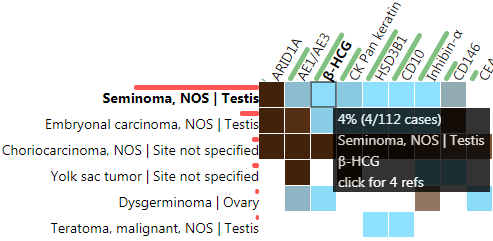
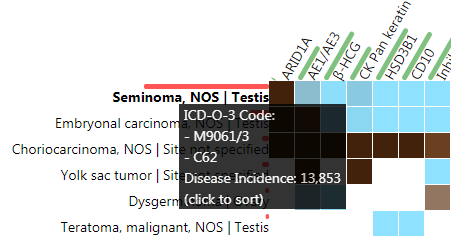
Hover/click on tiles and labels to see additional information
References
Literature
- SALL4 expression in germ cell and non-germ cell tumors: a systematic immunohistochemical study of 3215 cases.
- Expression of TTF-1 and cytokeratins in primary and secondary epithelial lung tumours: correlation with histological type and grade.
- IMP3 distinguishes uterine serous carcinoma from endometrial endometrioid adenocarcinoma.
- A panel of immunohistochemical stains assists in the distinction between ovarian and renal clear cell carcinoma.
- Immunohistochemical evaluation of CON6D/B5: a new CD30 monoclonal antibody.
- Overexpression of EGFR and absence of C-KIT expression correlate with poor prognosis in salivary gland carcinomas.
- Renal carcinomas with the t(6;11)(p21;q12): clinicopathologic features and demonstration of the specific alpha-TFEB gene fusion by immunohistochemistry, RT-PCR, and DNA PCR.
- Cytokeratin 7 and cytokeratin 20 expression in epithelial neoplasms: a survey of 435 cases.
- CDX-2 expression is a common event in primary intestinal-type endocervical adenocarcinoma.
- An assessment of the usefulness of immunohistochemical stains in the diagnosis of hairy cell leukemia.
- The homeobox intestinal differentiation factor CDX2 is selectively expressed in gastrointestinal adenocarcinomas.
- Thyroid transcription factor-1 is the superior immunohistochemical marker for pulmonary adenocarcinomas and large cell carcinomas compared to surfactant proteins A and B.
- Selective expression of trophoblastic hormones by lung carcinoma: neurendocrine tumors exclusively produce human chorionic gonadotropin alpha-subunit (hCGalpha).
- Mucinous bronchioloalveolar carcinomas display a specific pattern of mucin gene expression among primary lung adenocarcinomas.
- Cytokeratin 7: a useful adjunct in the diagnosis of chromophobe renal cell carcinoma.
- Expression of syndecan-1 is common in human lung cancers independent of expression of epidermal growth factor receptor.
- Thrombomodulin expression in transitional cell carcinoma.
- Stathmin-1 expression as a complement to p16 helps identify high-grade cervical intraepithelial neoplasia with increased specificity.
- A comprehensive analysis of PAX8 expression in human epithelial tumors.
- PAX2 expression in Wilms tumors and other childhood neoplasms.
- Parachordoma is immunohistochemically and cytogenetically distinct from axial chordoma and extraskeletal myxoid chondrosarcoma.
- Differential expression of MUC2 and MUC5AC mucin genes in primary ovarian and metastatic colonic carcinoma.
- Uroplakin II (UPII), GATA3, and p40 are Highly Sensitive Markers for the Differential Diagnosis of Invasive Urothelial Carcinoma.
- Immunohistochemical staining of GLUT1 in benign, borderline, and malignant ovarian epithelia.
- Perivascular epithelioid cell tumor ('PEComa') of the uterus: a subset of HMB-45-positive epithelioid mesenchymal neoplasms with an uncertain relationship to pure smooth muscle tumors.
- Immunohistochemical panel to identify the primary site of invasive micropapillary carcinoma.
- NKX6-1 Is a Novel Immunohistochemical Marker for Pancreatic and Duodenal Neuroendocrine Tumors.
- Determination of lung as the primary site of cerebral metastatic adenocarcinomas using monoclonal antibody to thyroid transcription factor-1.
- Concurrent evaluation of p53, beta-catenin, and alpha-fetoprotein expression in human hepatocellular carcinoma.
- Cadherin-17 is a useful diagnostic marker for adenocarcinomas of the digestive system.
- Diagnostic value of markers M2A, OCT3/4, AP-2gamma, PLAP and c-KIT in the detection of extragonadal seminomas.
- Differential expression of E-cadherin in lobular and ductal neoplasms of the breast and its biologic and diagnostic implications.
- The oncofetal protein IMP3: a novel biomarker for endometrial serous carcinoma.
- Mucinous and nonmucinous bronchioloalveolar adenocarcinomas have distinct staining patterns with thyroid transcription factor and cytokeratin 20 antibodies.
- Uroplakin is not a reliable immunohistochemical marker for malignant mesothelioma of the pleura.
- SOX2 is highly expressed in squamous cell carcinomas of the gastrointestinal tract.
- Immunostaining in the diagnosis of pulmonary neuroendocrine carcinomas. An immunohistochemical study with ultrastructural correlations.
- Expression of TdT in Merkel cell carcinoma and small cell lung carcinoma.
- Immunocytochemical detection of carcinoembryonic antigen in conventional histopathology specimens.
- Hepatocyte antigen as a marker of intestinal metaplasia.
- Foamy gland pattern of pancreatic ductal adenocarcinoma: a deceptively benign-appearing variant.
- Pathogenesis of colloid (pure mucinous) carcinoma of exocrine organs: Coupling of gel-forming mucin (MUC2) production with altered cell polarity and abnormal cell-stroma interaction may be the key factor in the morphogenesis and indolent behavior of colloid carcinoma in the breast and pancreas.
- Usefulness of Cdx2 in separating mucinous bronchioloalveolar adenocarcinoma of the lung from metastatic mucinous colorectal adenocarcinoma.
- Melan A (A103) is not a marker of mesothelioma.
- CD117, CK20, TTF-1, and DNA topoisomerase II-alpha antigen expression in small cell tumors.
- Mammaglobin vs GCDFP-15: an immunohistologic validation survey for sensitivity and specificity.
- Overexpression of KIT (CD117) in chromophobe renal cell carcinoma and renal oncocytoma.
- Immunohistochemistry in the differential diagnosis of liver carcinomas.
- Expression of mucins, SIMA, villin, and CDX2 in small-intestinal adenocarcinoma.
- Diagnostic value of inhibin immunoreactivity in ovarian gonadal stromal tumours and their histological mimics.
- Carcinoma of the collecting ducts of Bellini and renal medullary carcinoma: clinicopathologic analysis of 52 cases of rare aggressive subtypes of renal cell carcinoma with a focus on their interrelationship.
- The significance of GATA3 expression in breast cancer: a 10-year follow-up study.
- Vulvar lichen sclerosus and squamous cell carcinoma: a cohort, case control, and investigational study with historical perspective; implications for chronic inflammation and sclerosis in the development of neoplasia.
- Does human papillomavirus infection imply a different prognosis in vulvar squamous cell carcinoma?
- Differential expression of WT-1 in serous carcinomas in the peritoneum with or without associated serous carcinoma in endometrial polyps.
- Diagnostic implications of transcription factor Pax 2 protein and transmembrane enzyme complex carbonic anhydrase IX immunoreactivity in adult renal epithelial neoplasms.
- Absence of carcinoembryonic antigen-like material in mesothelioma: an immunohistochemical differentiation from other lung cancers.
- Clear-cell papillary renal cell carcinoma: molecular and immunohistochemical analysis with emphasis on the von Hippel-Lindau gene and hypoxia-inducible factor pathway-related proteins.
- Immunohistochemical staining for calretinin is useful in the diagnosis of ovarian sex cord-stromal tumours.
- Clinicopathologic correlation of beclin-1 and bcl-2 expression in human breast cancer.
- Prognostic value of cell cycle and apoptosis regulatory proteins in mismatch repair-proficient colorectal cancer: a tissue microarray-based approach.
- CpG island methylator phenotype-low (CIMP-low) in colorectal cancer: possible associations with male sex and KRAS mutations.
- An immunohistochemical study of cervical neuroendocrine carcinomas: Neoplasms that are commonly TTF1 positive and which may express CK20 and P63.
- Abnormal expression of E-cadherin in tumor cells is associated with poor prognosis of gastric carcinoma.
- Uroplakins, specific membrane proteins of urothelial umbrella cells, as histological markers of metastatic transitional cell carcinomas.
- How useful is alpha-methylacyl-CoA racemase (AMACR) immunohistochemistry in the differential diagnosis of kidney cancers?
- Molecular profile of grade 3 endometrioid endometrial carcinoma: is it a type I or type II endometrial carcinoma?
- HBME-1 and antithrombomodulin in the differential diagnosis of malignant mesothelioma of pleura.
- Carbonic anhydrase IX expression in renal neoplasms: correlation with tumor type and grade.
- The expression of subunits of human chorionic gonadotropin (hCG) by nontrophoblastic, nonendocrine, and endocrine tumors.
- Upregulation of vimentin and aberrant expression of E-cadherin/beta-catenin complex in oral squamous cell carcinomas: correlation with the clinicopathological features and patient outcome.
- Thyroid transcription factor-1 expression in breast carcinomas.
- Can CD10 be used as a diagnostic marker in thyroid pathology?
- Protein overexpression and gene amplification of HER-2 and EGFR in colorectal cancers: an immunohistochemical and fluorescent in situ hybridization study.
- The use of vimentin antibodies in the diagnosis of malignant mesothelioma.
- Keratin proteins and carcinoembryonic antigen in lung carcinoma: an immunoperoxidase study of fifty-four cases, with ultrastructural correlations.
- Classical-type invasive lobular carcinoma with HER2 overexpression: clinical, histologic, and hormone receptor characteristics.
- Morphologic spectrum of immunohistochemically characterized clear cell carcinoma of the ovary: a study of 155 cases.
- Transition from squamous cell carcinoma to adenocarcinoma in adenosquamous carcinoma of the lung.
- Immunohistochemical expression of cytokeratins in intrahepatic cholangiocarcinoma and metastatic adenocarcinoma of the liver.
- c-kit gene mutation and CD117 expression in human anorectal melanomas.
- Neuroendocrine differentiation and prognosis in breast adenocarcinoma.
- Characterization of CD24 expression in intraductal papillary mucinous neoplasms and ductal carcinoma of the pancreas.
- Adrenal cortical tumors clinically mimicking pheochromocytoma.
- Chromogenic in situ hybridization to detect EGFR gene copy number in cell blocks from fine-needle aspirates of non small cell lung carcinomas and lung metastases from colo-rectal cancer.
- Expression of c-erbB-2 oncoprotein in different types of thyroid tumors: an immunohistochemical study.
- Immunohistochemical detection of neuroblastomatous foci in composite adrenal pheochromocytoma-neuroblastoma.
- p16 expression in primary ovarian mucinous and endometrioid tumors and metastatic adenocarcinomas in the ovary: utility for identification of metastatic HPV-related endocervical adenocarcinomas.
- Keratinizing-type squamous cell carcinoma of the oropharynx: p16 overexpression is associated with positive high-risk HPV status and improved survival.
- Does CD10 immunoexpression have a diagnostic utility in the differential diagnosis of renal oncocytomas and eosinophilic variants of chromophobe renal cell carcinomas?
- Co-expression of N-cadherin and alpha-fetoprotein in stomach cancer.
- Combined expression of p161NK4a and p27Kip1, but not p21WAF1, differentiates endocervical from endometrial adenocarcinoma.
- A triple stain of reticulin, glypican-3, and glutamine synthetase: a useful aid in the diagnosis of liver lesions.
- The CD44v6-negative phenotype in high-grade uterine carcinomas correlates with serous histologic subtype.
- α-Methylacyl-CoA racemase (AMACR) in gastric cancer: correlation with clinicopathologic data and disease-free survival.
- Expression of P-glycoprotein in hepatocellular carcinoma. A determinant of chemotherapy response.
- Expression of p27 and VHL in renal tumors.
- Differential immunoprofiles of hepatocellular carcinoma, renal cell carcinoma, and adrenocortical carcinoma: a systemic immunohistochemical survey using tissue array technique.
- Chromophobe renal cell carcinoma with microcystic and adenomatous arrangement and pigmentation--a diagnostic pitfall. Morphological, immunohistochemical, ultrastructural and molecular genetic report of 20 cases.
- The utility of calretinin, inhibin, and WT1 immunohistochemical staining in the differential diagnosis of ovarian tumors.
- Cytokeratin 20 immunoreactivity distinguishes Merkel cell (primary cutaneous neuroendocrine) carcinomas and salivary gland small cell carcinomas from small cell carcinomas of various sites.
- Comparison of immunohistochemical markers in the differential diagnosis of adrenocortical tumors: immunohistochemical analysis of adrenocortical tumors.
- The role of calretinin, inhibin, melan-A, BCL-2, and C-kit in differentiating adrenal cortical and medullary tumors: an immunohistochemical study.
- The alpha subunit of inhibin in adrenal cortical neoplasia.
- Immunoexpression of inhibin alpha-subunit in adrenal neoplasms.
- Comparative immunohistochemical profile of hepatocellular carcinoma, cholangiocarcinoma, and metastatic adenocarcinoma.
- SALL4 is a novel sensitive and specific marker of ovarian primitive germ cell tumors and is particularly useful in distinguishing yolk sac tumor from clear cell carcinoma.
- 'Scirrhous' type hepatocellular carcinomas: a special reference to expression of cytokeratin 7 and hepatocyte paraffin 1.
- Value of immunohistochemistry in the differential diagnosis of pleural sarcomatoid mesothelioma from lung sarcomatoid carcinoma.
- Utility of D2-40, a novel mesothelial marker, in the diagnosis of malignant mesothelioma.
- Podoplanin is a better immunohistochemical marker for sarcomatoid mesothelioma than calretinin.
- CD10 is a marker for normal and neoplastic endometrial stromal cells.
- CD10 immunoreactivity in sarcomatoid carcinomas: comparison with true sarcomas.
- Diagnostic immunohistochemistry in uterine sarcomas: a study of 397 cases.
- An immunohistochemical analysis of endometrial stromal and smooth muscle tumors of the uterus: a study of 54 cases emphasizing the importance of using a panel because of overlap in immunoreactivity for individual antibodies.
- Paraffin-section detection of CD10 in 505 nonhematopoietic neoplasms. Frequent expression in renal cell carcinoma and endometrial stromal sarcoma.
- Utility of CD10 in distinguishing between endometrial stromal sarcoma and uterine smooth muscle tumors: an immunohistochemical comparison of 34 cases.
- Use of oxytocin receptor expression in distinguishing between uterine smooth muscle tumors and endometrial stromal sarcoma.
- Distinction of endometrial stromal sarcomas from 'hemangiopericytomatous' tumors using a panel of immunohistochemical stains.
- Endometrial stromal sarcoma: clinicopathological and immunophenotype study of 18 cases.
- Use of histone deacetylase 8 (HDAC8), a new marker of smooth muscle differentiation, in the classification of mesenchymal tumors of the uterus.
- Immunohistochemical differential diagnosis between large cell neuroendocrine carcinoma and small cell carcinoma by tissue microarray analysis with a large antibody panel.
- Tissue-sparing application of the newly proposed IASLC/ATS/ERS classification of adenocarcinoma of the lung shows practical diagnostic and prognostic impact.
- Immunoreactivity for epithelial and neuroendocrine antibodies are useful in the differential diagnosis of lung carcinomas.
- Immunohistochemistry in the differential diagnostics of primary lung cancer: an investigation within the Southern Swedish Lung Cancer Study.
- The diagnostic utility of immunohistochemistry in distinguishing primary skin adnexal carcinomas from metastatic adenocarcinoma to skin: an immunohistochemical reappraisal using cytokeratin 15, nestin, p63, D2-40, and calretinin.
- The immunohistochemical profile of Spitz nevi and conventional (non-Spitzoid) melanomas: a baseline study.
- The immunohistochemical diagnosis of mesothelioma: a comparative study of epithelioid mesothelioma and lung adenocarcinoma.
- Myxoid neoplasms of the adrenal cortex: a rare histologic variant.
- Wilms tumor gene product: sensitive and contextually specific marker of serous carcinomas of ovarian surface epithelial origin.
- Value of thyroid transcription factor-1, E-cadherin, BG8, WT1, and CD44S immunostaining in distinguishing epithelial pleural mesothelioma from pulmonary and nonpulmonary adenocarcinoma.
- h-Caldesmon in leiomyosarcoma and tumors with smooth muscle cell-like differentiation: its specific expression in the smooth muscle cell tumor.
- Uroplakin III is a highly specific and moderately sensitive immunohistochemical marker for primary and metastatic urothelial carcinomas.
- Application of mesothelin immunostaining in tumor diagnosis.
- The distinction of clear cell carcinoma of the female genital tract, clear cell renal cell carcinoma, and translocation-associated renal cell carcinoma: an immunohistochemical study using tissue microarray.
- P16INK4A and survivin: Diagnostic and prognostic markers in cervical intraepithelial neoplasia and cervical squamous cell carcinoma.
- Expression of CD163 (hemoglobin scavenger receptor) in normal tissues, lymphomas, carcinomas, and sarcomas is largely restricted to the monocyte/macrophage lineage.
- Value of thyroid transcription factor-1 immunostaining in distinguishing small cell lung carcinomas from other small cell carcinomas.
- P21 Cip1/WAF1 expression is strongly associated with HPV-positive tonsillar carcinoma and a favorable prognosis.
- Hep par 1 antibody stain for the differential diagnosis of hepatocellular carcinoma: 676 tumors tested using tissue microarrays and conventional tissue sections.
- Hepatocyte paraffin 1 expression in human normal and neoplastic tissues: tissue microarray analysis on 3,940 tissue samples.
- Hepatocyte paraffin 1: a monoclonal antibody that reacts with hepatocytes and can be used for differential diagnosis of hepatic tumors.
- Keratin 1 expression in endothelia and mesenchymal tumors: an immunohistochemical analysis of normal and neoplastic tissues.
- The expression of trophoblastic cell markers by lung carcinomas.
- A novel monoclonal antibody against DOG1 is a sensitive and specific marker for gastrointestinal stromal tumors.
- GATA3: a multispecific but potentially useful marker in surgical pathology: a systematic analysis of 2500 epithelial and nonepithelial tumors.
- Use of antibodies against estrogen and progesterone receptors to identify metastatic breast and ovarian carcinomas by conventional immunohistochemical and tyramide signal amplification methods.
- Adenocarcinoma in the lung in patients with breast cancer. A prospective analysis of the discriminatory value of immunohistology.
- Immunohistochemical identification of tumor markers in metastatic adenocarcinoma. A diagnostic adjunct in the determination of primary site.
- Markers of adenocarcinoma characteristic of the site of origin: development of a diagnostic algorithm.
- The immunohistochemical diagnosis of mesothelioma. Differentiation of mesothelioma and lung adenocarcinoma.
- Estrogen receptor detection in paraffin sections of adenocarcinoma of the colon, pancreas, and lung.
- A study of immunohistochemical differential expression in pulmonary and mammary carcinomas.
- Immunohistochemical expression of estrogen receptor in adenocarcinomas of the lung: the antibody factor.
- In search of the ideal immunopanel to distinguish metastatic mammary carcinoma from primary lung carcinoma: a tissue microarray study of 207 cases.
- Association between hormone receptor expression and epidermal growth factor receptor mutation in patients operated on for non-small cell lung cancer.
- Metastatic adenocarcinoma to the brain: an immunohistochemical approach.
- Panels of immunohistochemical markers help determine primary sites of metastatic adenocarcinoma.
- Immunoprofile of ovarian tumors with putative transitional cell (urothelial) differentiation using novel urothelial markers: histogenetic and diagnostic implications.
- OCT4: a novel biomarker for dysgerminoma of the ovary.
- D2-40 and podoplanin are highly specific and sensitive immunohistochemical markers of epithelioid malignant mesothelioma.
- Can we tell the site of origin of metastatic squamous cell carcinoma? An immunohistochemical tissue microarray study of 194 cases.
- GLUT-1 expression in mesenchymal tumors: an immunohistochemical study of 247 soft tissue and bone neoplasms.
- The value of immunocytochemistry in distinguishing between clear cell carcinoma of the kidney and ovary.
- Myxoid adrenocortical neoplasms: a study of the clinicopathologic features and EGFR gene status of ten Chinese cases.
- Sox2 expression in pulmonary non-small cell and neuroendocrine carcinomas.
- p53 alterations in atypical alveolar hyperplasia of the human lung.
- Primary lung adenocarcinoma with massive lymphocyte infiltration.
- Association of p53 codon 72 genotypes and clinical outcome in human papillomavirus-infected lung cancer patients.
- Tumor oncogenic expression in malignant effusions as a possible method to enhance cytologic diagnostic sensitivity. An immunocytochemical study of 87 cases.
- Prognostic value of immunohistochemical expressions of p53, HER-2/neu, and bcl-2 in stage I non-small-cell lung cancer.
- Loss of FHIT protein expression is related to high proliferation, low apoptosis and worse prognosis in non-small-cell lung cancer.
- Immunohistochemistry can help distinguish metastatic pancreatic adenocarcinomas from bile duct adenomas and hamartomas of the liver.
- Multidrug resistance-associated protein and mutant p53 protein expression in non-small cell lung cancer.
- p53 immunostaining in the differentiation of reactive processes from malignancy in pleural biopsy specimens.
- Pulmonary adenocarcinoma with a micropapillary pattern: a clinicopathological, immunophenotypic and molecular analysis.
- Association of p53 protein expression in stage I lung adenocarcinoma with reference to cytological subtypes.
- Immunohistochemical analysis of p53 mutations in bronchioloalveolar carcinoma and conventional pulmonary adenocarcinoma.
- Expression signatures in lung cancer reveal a profile for EGFR-mutant tumours and identify selective PIK3CA overexpression by gene amplification.
- TTF-1 expression in pulmonary adenocarcinomas.
- Analysis of expression patterns of breast cancer-specific markers (mammaglobin and gross cystic disease fluid protein 15) in lung and pleural tumors.
- Expression of KIT (CD117) in neoplasms of the head and neck: an ancillary marker for adenoid cystic carcinoma.
- CDX2, a highly sensitive and specific marker of adenocarcinomas of intestinal origin: an immunohistochemical survey of 476 primary and metastatic carcinomas.
- Immunophenotyping of serous carcinoma of the female genital tract.
- Gastrointestinal immunophenotype in adenocarcinomas of the uterine cervix and related glandular lesions: a possible link between lobular endocervical glandular hyperplasia/pyloric gland metaplasia and 'adenoma malignum'.
- Immunoreactivity of a new CD5 antibody with normal epithelium and malignant tumors including thymic carcinoma.
- Immunohistochemical analysis of hepatocellular and adenocarcinoma in the liver: MOC31 compares favorably with other putative markers.
- Utility of immunohistochemistry in distinguishing primary adenocarcinomas from metastatic breast carcinomas in the gastrointestinal tract.
- Patterns of distribution of cytokeratins 20 and 7 in special types of invasive breast carcinoma: a study of 123 cases.
- Keratins 7 and 20 as diagnostic markers of carcinomas metastatic to the ovary.
- The value of cytokeratins 20 and 7 in discriminating metastatic adenocarcinomas from pleural mesotheliomas.
- Utility of tissue-specific transcription factors thyroid transcription factor 1 and Cdx2 in determining the primary site of metastatic adenocarcinomas to the brain.
- Brachyury expression in extra-axial skeletal and soft tissue chordomas: a marker that distinguishes chordoma from mixed tumor/myoepithelioma/parachordoma in soft tissue.
- CK7+/CK20- immunoexpression profile is typical of salivary gland neoplasia.
- Distinction of high-grade neuroendocrine carcinoma/small cell carcinoma from conventional urothelial carcinoma of urinary bladder: an immunohistochemical approach.
- Clear cell carcinomas of the ovary: a multi-institutional study of 129 cases in Korea with prognostic significance of Emi1 and Galectin-3.
- Neuroendocrine marker expression in thyroid epithelial tumors.
- Lymphoid monoclonal antibodies reactive with lung tumors. Diagnostic applications.
- Mucinous carcinoma of the skin, primary, and secondary: a clinicopathologic study of 63 cases with emphasis on the morphologic spectrum of primary cutaneous forms: homologies with mucinous lesions in the breast.
- Calretinin: a novel immunocytochemical marker for mesothelioma.
- Value of thrombomodulin immunostaining in the diagnosis of transitional cell carcinoma: a comparative study with carcinoembryonic antigen.
- Distinguishing prostatic from colorectal adenocarcinoma on biopsy samples: the role of morphology and immunohistochemistry.
- Extrapulmonary small cell carcinomas express K homology domain containing protein overexpressed in cancer, but carcinoid tumors do not.
- Expression of Galectin-3 in renal neoplasms: a diagnostic, possible prognostic marker.
- Expression of the embryonic stem cell transcription factor SOX2 in human skin: relevance to melanocyte and merkel cell biology.
- Keratin subsets in papillary and follicular thyroid lesions. A paraffin section analysis with diagnostic implications.
- A comparative evaluation of immunohistochemical markers for the differential diagnosis of malignant pleural tumours.
- MIC2 is a specific marker for Ewing's sarcoma and peripheral primitive neuroectodermal tumors. Evidence for a common histogenesis of Ewing's sarcoma and peripheral primitive neuroectodermal tumors from MIC2 expression and specific chromosome aberration.
- Immunohistochemical profile of monoclonal antibody O13: antibody that recognizes glycoprotein p30/32MIC2 and is useful in diagnosing Ewing's sarcoma and peripheral neuroepithelioma.
- Expression of epidermal growth factor family proteins and epidermal growth factor receptor in human endometrium.
- A broad survey of cathepsin K immunoreactivity in human neoplasms.
- Value of thyroid transcription factor-1 and surfactant apoprotein A in the differential diagnosis of pulmonary carcinomas: a study of 109 cases.
- Absence of gene mutations in KIT-positive carcinoma showing thymus-like elements of the thyroid.
- Thyroid transcription factor-1, thyroglobulin, cytokeratin 7, and cytokeratin 20 in thyroid neoplasms.
- CD31 immunoreactivity in carcinomas and mesotheliomas.
- Cdx2 protein expression in normal and malignant human tissues: an immunohistochemical survey using tissue microarrays.
- CDX-2 homeobox gene expression is a reliable marker of colorectal adenocarcinoma metastases to the lungs.
- Diffuse malignant mesothelioma of the peritoneum and pleura, analysis of markers.
- Expression of calretinin and other mesothelioma-related markers in thymic carcinoma and thymoma.
- Glucose transporter-1 in pulmonary neuroendocrine carcinomas: expression and survival analysis.
- Anti-CD10 (56C6) is expressed variably in adrenocortical tumors and cannot be used to discriminate clear cell renal cell carcinomas.
- MN antigen expression in normal, preneoplastic, and neoplastic esophagus: a clinicopathological study of a new cancer-associated biomarker.
- The myoepithelial immunophenotype in 135 benign and malignant salivary gland tumors other than pleomorphic adenoma.
- Distribution of cytokeratins and vimentin in adult renal neoplasms and normal renal tissue: potential utility of a cytokeratin antibody panel in the differential diagnosis of renal tumors.
- 34betaE12 Cytokeratin Immunodetection in the Differential Diagnosis of Small Cell Tumors of Lung.
- 34BetaE12 expression along the whole spectrum of neuroendocrine proliferations of the lung, from neuroendocrine cell hyperplasia to small cell carcinoma.
- Progesterone receptor reactivity in renal oncocytoma and chromophobe renal cell carcinoma.
- Immunohistochemical and molecular characterization of clear cell carcinoma of the lung.
- CDX2 immunostaining as a gastrointestinal marker: expression in lung carcinomas is a potential pitfall.
- CD10 is expressed in most epithelioid hemangioendotheliomas: a potential diagnostic pitfall.
- The applicability of a keratin 7 monoclonal antibody in routinely Papanicolaou-stained cytologic specimens for the differential diagnosis of carcinomas.
- Optimal combination of immunohistochemical markers for subclassification of non-small cell lung carcinomas: A tissue microarray study of poorly differentiated areas.
- Cadherin-17 and SATB2 are sensitive and specific immunomarkers for medullary carcinoma of the large intestine.
- Distinct expression patterns of E-cadherin and beta-catenin in signet ring cell carcinoma components of primary pulmonary adenocarcinoma.
- miR-205 Expression levels in nonsmall cell lung cancer do not always distinguish adenocarcinomas from squamous cell carcinomas.
- Pulmonary adenocarcinomas with enteric differentiation: histologic and immunohistochemical characteristics compared with metastatic colorectal cancers and usual pulmonary adenocarcinomas.
- Peripheral pulmonary adenocarcinomas with bronchioloalveolar features: immunophenotypes correlate with histologic patterns.
- Subclassification of non-small cell lung carcinomas lacking morphologic differentiation on biopsy specimens: Utility of an immunohistochemical panel containing TTF-1, napsin A, p63, and CK5/6.
- Thyroid transcription factor-1 and cytokeratins 7 and 20 in pulmonary and breast carcinoma.
- Pulmonary intestinal-type adenocarcinoma does not show enteric differentiation by immunohistochemical study.
- Diagnostic tools for differentiating between pleural mesothelioma and lung adenocarcinoma in paraffin embedded tissue. Part I: Immunohistochemical findings.
- Expression of cytokeratin 20 in mucinous bronchioloalveolar carcinoma.
- Primary oncocytic adenocarcinomas of the lung: a clinicopathologic, immunohistochemical, and molecular biologic analysis of 16 cases.
- TTF-1, cytokeratin 7, 34betaE12, and CD56/NCAM immunostaining in the subclassification of large cell carcinomas of the lung.
- Villin, cytokeratin 7, and cytokeratin 20 expression in pulmonary adenocarcinoma with ultrastructural evidence of microvilli with rootlets.
- CDX-2 Expression in Primary Lung Adenocarcinoma.
- Use of thyroid transcription factor 1, PE-10, and cytokeratins 7 and 20 in discriminating between primary lung carcinomas and metastatic lesions in fine-needle aspiration biopsy specimens.
- Cribriform adenocarcinoma of the lung: clinicopathologic, immunohistochemical, and molecular analysis of 15 cases of a distinctive morphologic subtype of lung adenocarcinoma.
- Utility of cytokeratin immunostaining in separating pulmonary adenocarcinomas from colonic adenocarcinomas.
- Increased expression of stem cell markers in malignant melanoma.
- Abundant expression of AMACR in many distinct tumour types.
- Immunohistochemical detection of P504S in primary and metastatic renal cell carcinomas.
- Small cell carcinoma of the bladder: a contemporary clinicopathological study of 51 cases.
- Expression of FKBP12 in benign and malignant vascular endothelium: an immunohistochemical study on conventional sections and tissue microarrays.
- Cytokeratin 14 expression in epithelial neoplasms: a survey of 435 cases with emphasis on its value in differentiating squamous cell carcinomas from other epithelial tumours.
- The diagnostic utility of MOC31, BerEP4, RCC marker and CD10 in the classification of renal cell carcinoma and renal oncocytoma: an immunohistochemical analysis of 328 cases.
- Role of immunohistochemistry in the evaluation of needle core biopsies in adult renal cortical tumors: an ex vivo study.
- CD10+ and CK7/RON- immunophenotype distinguishes renal cell carcinoma, conventional type with eosinophilic morphology from its mimickers.
- Chromophobe renal cell carcinoma: an immunohistochemical study of 21 Japanese cases.
- Chromophobe renal cell carcinoma: a comparative study of histological, immunohistochemical and ultrastructural features using high throughput tissue microarray.
- Immunohistochemical analysis of chromophobe renal cell carcinoma, renal oncocytoma, and clear cell carcinoma: an optimal and practical panel for differential diagnosis.
- Cytokeratins 7 and 20 immunoreactivity in chromophobe renal cell carcinomas and renal oncocytomas.
- Immunohistochemical analysis for cytokeratin 7, KIT, and PAX2: value in the differential diagnosis of chromophobe cell carcinoma.
- Caveolin-1 immunohistochemical analysis in differentiating chromophobe renal cell carcinoma from renal oncocytoma.
- Profiling and classification tree applied to renal epithelial tumours.
- Immunohistochemical profile of common epithelial neoplasms arising in the kidney.
- Diagnostic value of cytokeratin 7 and parvalbumin in differentiating chromophobe renal cell carcinoma from renal oncocytoma.
- Keratin immunohistochemistry in renal cell carcinoma subtypes and renal oncocytomas: a systematic analysis of 233 tumors.
- Utility of cytokeratin 7 for distinguishing chromophobe renal cell carcinoma from renal oncocytoma.
- Expression of aquaporins and PAX-2 compared to CD10 and cytokeratin 7 in renal neoplasms: a tissue microarray study.
- SOX2-silenced squamous cell carcinoma: a highly malignant form of esophageal cancer with SOX2 promoter hypermethylation.
- Aberration of epidermal growth factor receptor expression in bone and soft-tissue tumors: protein overexpression, gene amplification and activation of downstream molecules.
- Podoplanin is a useful diagnostic marker for epithelioid hemangioendothelioma of the liver.
- Endothelial cell markers CD31, CD34, and BNH9 antibody to H- and Y-antigens--evaluation of their specificity and sensitivity in the diagnosis of vascular tumors and comparison with von Willebrand factor.
- Angiomatoid carcinoma and 'angiosarcoma' of the thyroid gland. A spectrum of endothelial differentiation.
- Spindle cell (sarcomatoid) carcinoma of the breast: a clinicopathologic and immunohistochemical analysis of 29 cases.
- Metaplastic breast carcinomas: are they of myoepithelial differentiation?: immunohistochemical profile of the sarcomatoid subtype using novel myoepithelial markers.
- Is PAX2 a reliable marker in differentiating diffuse malignant mesotheliomas of peritoneum from serous carcinomas of müllerian origin?
- P16 expression in squamous cell carcinomas of cervix and bladder.
- Arginase-1: a new immunohistochemical marker of hepatocytes and hepatocellular neoplasms.
- PAX2 and PAX8 expression in primary and metastatic müllerian epithelial tumors: a comprehensive comparison.
- Immunohistochemical staining of Reg IV and claudin-18 is useful in the diagnosis of gastrointestinal signet ring cell carcinoma.
- Relationship between MUC5AC and altered expression of MLH1 protein in mucinous and non-mucinous colorectal carcinomas.
- KBA62 and PNL2: 2 new melanoma markers-immunohistochemical analysis of 1563 tumors including metastatic, desmoplastic, and mucosal melanomas and their mimics.
- Value of mesothelin immunostaining in the diagnosis of mesothelioma.
- Determining the site of origin of mucinous adenocarcinoma: an immunohistochemical study of 175 cases.
- Immunohistochemical analysis of clear cell carcinoma of the gynecologic tract.
- Characterization of a new monoclonal antibody against PAX5/BASP in 1525 paraffin-embedded human and animal tissue samples.
- A new Mel-CAM (CD146)-specific monoclonal antibody, MN-4, on paraffin-embedded tissue.
- TLE1 expression is not specific for synovial sarcoma: a whole section study of 163 soft tissue and bone neoplasms.
- Prostate marker immunoreactivity in salivary gland neoplasms. A rare pitfall in immunohistochemistry.
- Immunoreactivity for A103, an antibody to melan-A (Mart-1), in adrenocortical and other steroid tumors.
- Melan A (A103) is expressed in adrenocortical neoplasms but not in renal cell and hepatocellular carcinomas.
- A103 immunostaining in the diagnosis of adrenal cortical tumors: an immunohistochemical study of 316 cases.
- PTEN expression in renal cell carcinoma and oncocytoma and prognosis.
- Napsin A and thyroid transcription factor-1 expression in carcinomas of the lung, breast, pancreas, colon, kidney, thyroid, and malignant mesothelioma.
- EGFR mutant-specific immunohistochemistry has high specificity and sensitivity for detecting targeted activating EGFR mutations in lung adenocarcinoma.
- Epidermal growth factor receptor (EGFR) high gene copy number and activating mutations in lung adenocarcinomas are not consistently accompanied by positivity for EGFR protein by standard immunohistochemistry.
- Analysis of c-fos, c-jun, c-erbB1, c-erbB2 and c-myc in primary lung carcinomas and their lymph node metastases.
- Immunohistochemical studies of trophoblastic tumors.
- Morphologic features of adenocarcinoma of the lung predictive of response to the epidermal growth factor receptor kinase inhibitors erlotinib and gefitinib.
- Altered E-cadherin and epidermal growth factor receptor expressions are associated with patient survival in lung cancer: a study utilizing high-density tissue microarray and immunohistochemistry.
- EGFR mutations in lung adenocarcinomas: clinical testing experience and relationship to EGFR gene copy number and immunohistochemical expression.
- Diversity of epidermal growth factor receptor-mediated activation of downstream molecules in human lung carcinomas.
- High MET copy number and MET overexpression: poor outcome in non-small cell lung cancer patients.
- CD10 expression in epithelial tissues and tumors of the gynecologic tract: a useful marker in the diagnosis of mesonephric, trophoblastic, and clear cell tumors.
- DOG1 antibody in the differential diagnosis of gastrointestinal stromal tumors: a study of 1840 cases.
- Paraffin section detection of the c-kit gene product (CD117) in human tissues: value in the diagnosis of mast cell disorders.
- KIT and platelet-derived growth factor receptor alpha tyrosine kinase gene mutations and KIT amplifications in human solid tumors.
- MYB expression and translocation in adenoid cystic carcinomas and other salivary gland tumors with clinicopathologic correlation.
- Role for microphthalmia transcription factor in the diagnosis of metastatic malignant melanoma.
- Utility of immunohistochemistry in the evaluation of necrotic thyroid tumors.
- Carcinoembryonic antigen in medullary thyroid carcinoma: an immunohistochemical study applying six novel monoclonal antibodies.
- Anaplastic thyroid carcinoma. Immunocytochemical study of 32 cases.
- Carcinoembryonic antigen and nonspecific cross-reacting antigen in thyroid cancer. An immunocytochemical study using polyclonal and monoclonal antibodies.
- A novel panel of antibodies that segregates immunocytochemically poorly differentiated carcinoma from undifferentiated carcinoma of the thyroid gland.
- Glypican 3 expression in human nonneoplastic, preneoplastic, and neoplastic tissues: a tissue microarray analysis of 4,387 tissue samples.
- ERG rearrangement in small cell prostatic and lung cancer.
- POU5F1 (OCT3/4) identifies cells with pluripotent potential in human germ cell tumors.
- Expression of T/NK-cell and plasma cell antigens in nonhematopoietic epithelioid neoplasms. An immunohistochemical study of 447 cases.
- Diagnostic utility of IMP3 expression in thyroid neoplasms: a quantitative RT-PCR study.
- Immunohistochemical analysis of peritoneal mesothelioma and primary and secondary serous carcinoma of the peritoneum: antibodies to estrogen and progesterone receptors are useful.
- Epidermal growth factor receptor protein expression and genomic alterations in renal cell carcinoma.
- Utility of 123C3 monoclonal antibody against CD56 (NCAM) for the diagnosis of small cell carcinomas on paraffin sections.
- Selective immunohistochemical markers to distinguish between metastatic high-grade urothelial carcinoma and primary poorly differentiated invasive squamous cell carcinoma of the lung.
- Revisiting chordoma with brachyury, a "new age" marker: analysis of a validation study on 51 cases.
- CD5 labeling of thymic carcinomas and other nonlymphoid neoplasms.
- Tyrosinase expression in malignant melanoma, desmoplastic melanoma, and peripheral nerve tumors.
- Sox10: a pan-schwannian and melanocytic marker.
- Microphthalmia transcription factor in the immunohistochemical diagnosis of metastatic melanoma: comparison with four other melanoma markers.
- Expression of the B-cell proliferation marker MUM1 by melanocytic lesions and comparison with S100, gp100 (HMB45), and MelanA.
- Analysis of microphthalmia transcription factor expression in normal tissues and tumors, and comparison of its expression with S-100 protein, gp100, and tyrosinase in desmoplastic malignant melanoma.
- Immunohistochemical reevaluation of carbonic anhydrase IX (CA IX) expression in tumors and normal tissues.
- Microphthalmia transcription factor. A sensitive and specific melanocyte marker for MelanomaDiagnosis.
- N-cadherin serves as diagnostic biomarker in intrahepatic and perihilar cholangiocarcinomas.
- Hepatocyte antigen as a marker of hepatocellular carcinoma: an immunohistochemical comparison to carcinoembryonic antigen, CD10, and alpha-fetoprotein.
- Exocrine and endocrine modulation in common gastric carcinoma.
- Diagnosing primary and metastatic renal cell carcinoma: the use of the monoclonal antibody 'Renal Cell Carcinoma Marker'.
- HNF4α as a marker for invasive mucinous adenocarcinoma of the lung.
- TLE1 as a diagnostic immunohistochemical marker for synovial sarcoma emerging from gene expression profiling studies.
- Multiple-marker immunohistochemical phenotypes distinguishing malignant pleural mesothelioma from pulmonary adenocarcinoma.
- The value of antibodies 44-3A6, SM3, HBME-1, and thrombomodulin in differentiating epithelial pleural mesothelioma from lung adenocarcinoma: a comparative study with other commonly used antibodies.
- The diagnostic utility of immunohistochemistry in distinguishing between mesothelioma and renal cell carcinoma: a comparative study.
- The diagnostic value of thrombomodulin immunolocalization in serous effusions.
- h-caldesmon, calretinin, estrogen receptor, and Ber-EP4: a useful combination of immunohistochemical markers for differentiating epithelioid peritoneal mesothelioma from serous papillary carcinoma of the ovary.
- Expression of calretinin, thrombomodulin, keratin 5, and mesothelin in lung carcinomas of different types: an immunohistochemical analysis of 596 tumors in comparison with epithelioid mesotheliomas of the pleura.
- Thrombomodulin expression in malignant pleural mesothelioma and pulmonary adenocarcinoma.
- h-Caldesmon, a useful positive marker in the diagnosis of pleural malignant mesothelioma, epithelioid type.
- CD24 expression has a prognostic impact in breast carcinoma.
- The diagnostic utility of immunohistochemistry and electron microscopy in distinguishing between peritoneal mesotheliomas and serous carcinomas: a comparative study.
- Value of the mesothelium-associated antibodies thrombomodulin, cytokeratin 5/6, calretinin, and CD44H in distinguishing epithelioid pleural mesothelioma from adenocarcinoma metastatic to the pleura.
- Immunohistochemical analysis of nuclear versus cytoplasmic staining of WT1 in malignant mesotheliomas and primary pulmonary adenocarcinomas.
- Immunohistochemical panels for differentiating epithelial malignant mesothelioma from lung adenocarcinoma: a study with logistic regression analysis.
- Calretinin, thrombomodulin, CEA, and CD15: a useful combination of immunohistochemical markers for differentiating pleural epithelial mesothelioma from peripheral pulmonary adenocarcinoma.
- Classification of low-grade neuroendocrine tumors of midgut and unknown origin.
- Usefulness of p16 for differentiating primary pulmonary squamous cell carcinoma from cervical squamous cell carcinoma metastatic to the lung.
- Immunohistologic analysis of gastrointestinal and pulmonary carcinoid tumors.
- Colonic adenocarcinoma metastatic to the urinary tract versus primary tumors of the urinary tract with glandular differentiation: a report of 7 cases and investigation using a limited immunohistochemical panel.
- Diagnostic utility of thyroid transcription factors Pax8 and TTF-2 (FoxE1) in thyroid epithelial neoplasms.
- Cytoplasmic immunoreactivity for thyroid transcription factor-1 in hepatocellular carcinoma: a comparative immunohistochemical analysis of four commercial antibodies using a tissue array technique.
- Comparison of thyroid transcription factor-1 and hepatocyte antigen immunohistochemical analysis in the differential diagnosis of hepatocellular carcinoma, metastatic adenocarcinoma, renal cell carcinoma, and adrenal cortical carcinoma.
- Combination of napsin A and TTF-1 immunohistochemistry helps in differentiating primary lung adenocarcinoma from metastatic carcinoma in the lung.
- Variable sensitivity and specificity of TTF-1 antibodies in lung metastatic adenocarcinoma of colorectal origin.
- Napsin A, a new marker for lung adenocarcinoma, is complementary and more sensitive and specific than thyroid transcription factor 1 in the differential diagnosis of primary pulmonary carcinoma: evaluation of 1674 cases by tissue microarray.
- Leu-M1 antigen in human neoplasms. An immunohistologic study of 400 cases.
- Differential expression of WT1 and p53 in serous and endometrioid carcinomas of the endometrium.
- Are the uterine serous carcinomas underdiagnosed? Histomorphologic and immunohistochemical correlates and clinical follow up in high-grade endometrial carcinomas initially diagnosed as high-grade endometrioid carcinoma.
- Immunohistochemical profile of endometrial adenocarcinoma: a study of 61 cases and review of the literature.
- Differentiation of ovarian mucinous carcinoma and metastatic colorectal adenocarcinoma by immunostaining with beta-catenin.
- Potential utility of uroplakin III, thrombomodulin, high molecular weight cytokeratin, and cytokeratin 20 in noninvasive, invasive, and metastatic urothelial (transitional cell) carcinomas.
- Cytokeratin expression profile in gastric carcinomas.
- Cytokeratin expression patterns in noncardia, intestinal metaplasia-associated gastric adenocarcinoma: implication for the evaluation of intestinal metaplasia and tumors at the esophagogastric junction.
- Expression of cytokeratins 7 and 20 in primary carcinomas of the stomach and colorectum and their value in the differential diagnosis of metastatic carcinomas to the ovary.
- The immunohistochemical discrimination of endometrioid adenocarcinomas.
- A panel of immunohistochemical stains, including carcinoembryonic antigen, vimentin, and estrogen receptor, aids the distinction between primary endometrial and endocervical adenocarcinomas.
- The glypican 3 oncofetal protein is a promising diagnostic marker for hepatocellular carcinoma.
- Senescence and apoptosis in carcinogenesis of cervical squamous carcinoma.
- p16(INK4a) is a useful marker of human papillomavirus integration allowing risk stratification for cervical malignancies.
- p16INK4A and p14ARF expression pattern by immunohistochemistry in human papillomavirus-related cervical neoplasia.
- Evaluation of p16INK4a and pRb expression in cervical squamous and glandular neoplasia.
- IMMUNOHISTOCHEMICAL EXPRESSION OF P16INK4a IN INFLAMMATORY, PRENEOPLASTIC AND NEOPLASTIC CERVICAL LESIONS.
- Dual stain immunohistochemical localization of p16INK4A and ki-67: a synergistic approach to identify clinically significant cervical mucosal lesions.
- Distribution of CA 125 in adenocarcinomas. An immunohistochemical study of 481 cases.
- Colon signet ring cell adenocarcinoma: immunohistochemical characterization and comparison with gastric and typical colon adenocarcinomas.
- The utility of estrogen receptor and progesterone receptor immunohistochemistry in the distinction of metastatic breast carcinoma from other tumors in the liver.
- A comparison of CD10 to pCEA, MOC-31, and hepatocyte for the distinction of malignant tumors in the liver.
- The best immunohistochemical panel for differentiating hepatocellular carcinoma from metastatic adenocarcinoma.
- Papillary serous carcinoma of the peritoneum in women. A clinicopathologic and immunohistochemical study.
- Immunohistochemical expression of cytokeratins 7 and 20 in malignant salivary gland tumors.
- Tissue microarray analysis of neuroendocrine differentiation and its prognostic significance in breast cancer.
- Immunophenotypic diversity of endometrial adenocarcinomas: implications for differential diagnosis.
- Clinicopathologic study of 62 acinar cell carcinomas of the pancreas: insights into the morphology and immunophenotype and search for prognostic markers.
- Value of p63 and cytokeratin 5/6 as immunohistochemical markers for the differential diagnosis of poorly differentiated and undifferentiated carcinomas.
- Fibrolamellar carcinoma of the liver exhibits immunohistochemical evidence of both hepatocyte and bile duct differentiation.
- Diagnostic significance of aquaporin-1 in liver tumors.
- Canalicular immunostaining of neprilysin (CD10) as a diagnostic marker for hepatocellular carcinomas.
- Expression of cytokeratins 7 and 20 in ovarian neoplasia.
- Carcinoembryonic antigen in gynecologic patients. II. Immunohistological expression.
- Expression of p63 in cutaneous metastases.
- Alpha-methylacyl-CoA racemase as a marker in the differential diagnosis of metanephric adenoma.
- Expression of MUC2, MUC5AC, MUC5B, and MUC6 mucins in colorectal cancers and their association with the CpG island methylator phenotype.
- Immunohistochemical distinction of intestinal-type sinonasal adenocarcinoma from metastatic adenocarcinoma of intestinal origin.
- Mucin profiles in signet-ring cell carcinoma.
- Immunohistochemical analysis of colorectal cancer with gastric phenotype: claudin-18 is associated with poor prognosis.
- Immunohistochemical characterization of signet-ring cell carcinomas of the stomach, breast, and colon.
- Primary signet-ring cell carcinoma of the lung: histochemical and immunohistochemical characterization.
- Differential expression of MUC1, MUC2, and MUC5AC in carcinomas of various sites: an immunohistochemical study.
- The complex intratumoral heterogeneity of colon cancer highlighted by laser microdissection.
- Differential diagnosis of bladder versus colorectal adenocarcinoma: keratin 7 and GATA3 positivity in nuclear ß-catenin-negative glandular tumours defines adenocarcinoma of the bladder.
- Expression of mucins and cytokeratins in primary carcinomas of the digestive system.
- Loss of MUC2 expression predicts disease recurrence and poor outcome in colorectal carcinoma.
- Distinction of hepatocellular carcinoma from benign hepatic mimickers using Glypican-3 and CD34 immunohistochemistry.
- WT1, estrogen receptor, and progesterone receptor as markers for breast or ovarian primary sites in metastatic adenocarcinoma to body fluids.
- Immunohistochemistry for estrogen and progesterone receptors in the distinction of primary and metastatic mucinous tumors in the ovary: an analysis of 124 cases.
- Calponin and h-caldesmon in soft tissue tumors: consistent h-caldesmon immunoreactivity in gastrointestinal stromal tumors indicates traits of smooth muscle differentiation.
- Intracytoplasmic lipid accumulation in apocrine carcinoma of the breast evaluated with adipophilin immunoreactivity: a possible link between apocrine carcinoma and lipid-rich carcinoma.
- An immunohistochemical comparison of chordoma with renal cell carcinoma, colorectal adenocarcinoma, and myxopapillary ependymoma: a potential diagnostic dilemma in the diminutive biopsy.
- CD138 (syndecan-1), a plasma cell marker immunohistochemical profile in hematopoietic and nonhematopoietic neoplasms.
- Clinicopathological significance of nuclear PTEN expression in colorectal adenocarcinoma.
- Primary sclerosing neuroendocrine carcinomas of the lung: A clinicopathologic and immunohistochemical study of 10 cases.
- The value of thyroid transcription factor-1 in cytologic preparations as a marker for metastatic adenocarcinoma of lung origin.
- Diagnostic value of galectin-3, HBME-1, cytokeratin 19, high molecular weight cytokeratin, cyclin D1 and p27(kip1) in the differential diagnosis of thyroid nodules.
- Mutation and loss of expression of ARID1A in uterine low-grade endometrioid carcinoma.
- Reevaluation and identification of the best immunohistochemical panel (pVHL, Maspin, S100P, IMP-3) for ductal adenocarcinoma of the pancreas.
- Calretinin expression in tumors of adipose tissue.
- Sox9, a master regulator of chondrogenesis, distinguishes mesenchymal chondrosarcoma from other small blue round cell tumors.
- Nasopharyngeal adenocarcinomas: a clinicopathologic study of 44 cases including immunohistochemical features of 18 papillary phenotypes.
- Cytokeratins 7 and 20, Dpc4, and MUC5AC in the distinction of metastatic mucinous carcinomas in the ovary from primary ovarian mucinous tumors: Dpc4 assists in identifying metastatic pancreatic carcinomas.
- Value of a panel of antibodies to identify the primary origin of adenocarcinomas presenting as bladder carcinoma.
- DOG1 for the diagnosis of gastrointestinal stromal tumor (GIST): Comparison between 2 different antibodies.
- Napsin A is frequently expressed in clear cell carcinoma of the ovary and endometrium.
- p63 and TTF-1 immunostaining. A useful marker panel for distinguishing small cell carcinoma of lung from poorly differentiated squamous cell carcinoma of lung.
- The diagnostic utility of immunohistochemistry in distinguishing between epithelioid mesotheliomas and squamous carcinomas of the lung: a comparative study.
- p63 expression in assessment of bronchioloalveolar proliferations of the lung.
- Evaluation of napsin A, cytokeratin 5/6, p63, and thyroid transcription factor 1 in adenocarcinoma versus squamous cell carcinoma of the lung.
- A study of ΔNp63 expression in lung non-small cell carcinomas.
- Distinction of pulmonary small cell carcinoma from poorly differentiated squamous cell carcinoma: an immunohistochemical approach.
- Progenitor stem cell marker expression by pulmonary carcinomas.
- TTF-1 and p63 for distinguishing pulmonary small-cell carcinoma from poorly differentiated squamous cell carcinoma in previously pap-stained cytologic material.
- Usefulness of immunohistochemical and histochemical studies in the classification of lung adenocarcinoma and squamous cell carcinoma in cytologic specimens.
- p40 is the best marker for diagnosing pulmonary squamous cell carcinoma: comparison with p63, cytokeratin 5/6, desmocollin-3, and sox2.
- P63 in pulmonary epithelium, pulmonary squamous neoplasms, and other pulmonary tumors.
- Immunohistochemical algorithm for differentiation of lung adenocarcinoma and squamous cell carcinoma based on large series of whole-tissue sections with validation in small specimens.
- PAX3 expression in primary melanomas and nevi.
- Distinction of pulmonary large cell neuroendocrine carcinoma from small cell lung carcinoma: a morphological, immunohistochemical, and molecular analysis.
- Arginase-1: a novel immunohistochemical marker of hepatocellular differentiation in fine needle aspiration cytology.
- Glypican-3 expression in gastrointestinal and pancreatic epithelial neoplasms.
- Arginase-1, HepPar-1, and Glypican-3 are the most effective panel of markers in distinguishing hepatocellular carcinoma from metastatic tumor on fine-needle aspiration specimens.
- Arginase-1 is a more sensitive marker of hepatic differentiation than HepPar-1 and glypican-3 in fine-needle aspiration biopsies.
- Thyroid transcription factor-1 is expressed in extrapulmonary small cell carcinomas but not in other extrapulmonary neuroendocrine tumors.
- The relationship between p16 expression and high-risk human papillomavirus infection in squamous cell carcinomas from sites other than uterine cervix: a study of 137 cases.
- Tissue microarray immunohistochemical expression of estrogen, progesterone, and androgen receptors in uterine leiomyomata and leiomyosarcoma.
- Small cell lung carcinoma (SCLC): a clinicopathologic study of 100 cases with surgical specimens.
- Frequent expression of glypican-3 in Merkel cell carcinoma: an immunohistochemical study of 55 cases.
- E-cadherin and calretinin: a useful combination of immunochemical markers for differentiation between mesothelioma and metastatic adenocarcinoma.
- Immunocytochemical panel for distinguishing between carcinoma and reactive mesothelial cells in body cavity fluids.
- Distinguishing chordoid meningiomas from their histologic mimics: an immunohistochemical evaluation.
- Overexpression of lymphoid enhancer-binding factor 1 (LEF1) in solid-pseudopapillary neoplasms of the pancreas.
- Diagnostic utility of CD10 in benign and malignant extrahepatic bile duct lesions.
- The P16/cyclin D1/Rb pathway in neuroendocrine tumors of the lung.
- Expression of CD10 predicts tumor progression and unfavorable prognosis in malignant melanoma.
- Collecting duct carcinoma of the kidney: an immunohistochemical evaluation of the use of antibodies for differential diagnosis.
- Distinguishing breast carcinoma from Müllerian serous carcinoma with mammaglobin and mesothelin.
- Sox2: a possible driver of the basal-like phenotype in sporadic breast cancer.
- Immunohistochemical expression of chromogranins A and B, prohormone convertases 2 and 3, and amidating enzyme in carcinoid tumors and pancreatic endocrine tumors.
- Immunohistochemical staining for CDX-2, PDX-1, NESP-55, and TTF-1 can help distinguish gastrointestinal carcinoid tumors from pancreatic endocrine and pulmonary carcinoid tumors.
- Value of Islet 1 and PAX8 in identifying metastatic neuroendocrine tumors of pancreatic origin.
- Islet 1 (Isl1) expression is a reliable marker for pancreatic endocrine tumors and their metastases.
- Usefulness of CDX2 and TTF-1 in differentiating gastrointestinal from pulmonary carcinoids.
- Differential diagnosis of serous papillary carcinoma of the gynaecological tract and basal breast carcinoma: an immunohistochemical approach.
- Prognostic value of thyroid transcription factor-1 in primary, resected, non-small cell lung carcinoma.
- Immunohistochemical staining for thyroid transcription factor-1: a helpful aid in discerning primary site of tumor origin in patients with brain metastases.
- Expression of thyroid transcription factor-1 in normal and neoplastic lung tissues.
- Immunoreactivity for thyroid transcription factor-1 in stage I non-small cell carcinomas of the lung.
- Thyroid transcription factor 1 and Napsin A double stain: utilizing different vendor antibodies for diagnosing lung adenocarcinoma.
- Thyroid transcription factor 1 and cytokeratins 1, 5, 10, 14 (34betaE12) expression in basaloid and large-cell neuroendocrine carcinomas of the lung.
- Surfactant proteins and thyroid transcription factor-1 in pulmonary and breast carcinomas.
- The histopathology of BRAF-V600E-mutated lung adenocarcinoma.
- Fluorescence in situ hybridization, immunohistochemistry, and next-generation sequencing for detection of EML4-ALK rearrangement in lung cancer.
- Prognostic significance of thyroid transcription factor-1 expression in both early-stage conventional adenocarcinoma and bronchioloalveolar carcinoma of the lung.
- TTF-1 protein expression in pleural malignant mesotheliomas and adenocarcinomas of the lung.
- Napsin A (TA02) is a useful alternative to thyroid transcription factor-1 (TTF-1) for the identification of pulmonary adenocarcinoma cells in pleural effusions.
- Immunocytochemical expression of tissue specific transcription factor-1 in lung carcinoma.
- FLI-1 distinguishes Ewing sarcoma from small cell osteosarcoma and mesenchymal chondrosarcoma.
- Desmocollin-3: a new marker of squamous differentiation in undifferentiated large-cell carcinoma of the lung.
- Utility of surfactant protein B precursor and thyroid transcription factor 1 in differentiating adenocarcinoma of the lung from malignant mesothelioma.
- Comparison of thyroid transcription factor-1 expression by 2 monoclonal antibodies in pulmonary and nonpulmonary primary tumors.
- Thyroid transcription factor-1 expression prevalence and its clinical implications in non-small cell lung cancer: a high-throughput tissue microarray and immunohistochemistry study.
- Diagnostic utility of thymic epithelial markers CD205 (DEC205) and Foxn1 in thymic epithelial neoplasms.
- Galectin-3 expression is ubiquitous in tumors of the sellar region, nervous system, and mimics: an immunohistochemical and RT-PCR study.
- Napsin A is a specific marker for ovarian clear cell adenocarcinoma.
- The utility of discovered on gastrointestinal stromal tumor 1 (DOG1) antibody in surgical pathology-the GIST of it.
- Immunohistochemical differentiation of metastatic breast carcinomas from metastatic adenocarcinomas of other common primary sites.
- Hepatocyte nuclear factor 4A expression discriminates gastric involvement by metastatic breast carcinomas from primary gastric adenocarcinomas.
- Diffuse membranous immunoreactivity for podoplanin (D2-40) distinguishes primary and metastatic seminomas from other germ cell tumors and metastatic neoplasms.
- Galectin-3, fibronectin-1, CITED-1, HBME1 and cytokeratin-19 immunohistochemistry is useful for the differential diagnosis of thyroid tumors.
- Cytokeratin 19 and galectin-3 immunohistochemistry in the differential diagnosis of solitary thyroid nodules.
- Usefulness of HBME-1, cytokeratin 19 and galectin-3 immunostaining in the diagnosis of thyroid malignancy.
- Reproducible and highly sensitive detection of the broad spectrum epithelial marker keratin 19 in routine cancer diagnosis.
- Tyrosinase, melan-A, and KBA62 as markers for the immunohistochemical identification of metastatic amelanotic melanomas on paraffin sections.
- Calretinin, a more sensitive but less specific marker than alpha-inhibin for ovarian sex cord-stromal neoplasms: an immunohistochemical study of 215 cases.
- Progesterone receptor immunoreactivity in pancreatic endocrine tumors. An immunocytochemical study of 156 neuroendocrine tumors of the pancreas, gastrointestinal and respiratory tracts, and skin.
- Is D2-40 a useful marker for distinguishing malignant mesothelioma from pulmonary adenocarcinoma and benign mesothelial proliferations?
- Immunohistochemical localization of inhibin-alpha in the placenta and gestational trophoblastic lesions.
- Neuroendocrine differentiation in hepatoblastoma. An immunohistochemical investigation.
- Immunohistochemical pitfalls and the importance of glypican 3 and arginase in the diagnosis of scirrhous hepatocellular carcinoma.
- Distribution of p63, cytokeratins 5/6 and cytokeratin 14 in 51 normal and 400 neoplastic human tissue samples using TARP-4 multi-tumor tissue microarray.
- Expression of WT1, CA 125, and GCDFP-15 as useful markers in the differential diagnosis of primary ovarian carcinomas versus metastatic breast cancer to the ovary.
- Neuroendocrine differentiation is a common feature of thymic carcinoma.
- Cytokeratin 7 and 20 expression in cholangiocarcinomas varies along the biliary tract but still differs from that in colorectal carcinoma metastasis.
- Cytokeratin profile relates to histological subtypes and intrahepatic location of intrahepatic cholangiocarcinoma and primary sites of metastatic adenocarcinoma of liver.
- Hep Par 1 and selected antibodies in the immunohistological distinction of hepatocellular carcinoma from cholangiocarcinoma, combined tumours and metastatic carcinoma.
- Immunohistochemical staining in the diagnosis of pancreatobiliary and ampulla of Vater adenocarcinoma: application of CDX2, CK17, MUC1, and MUC2.
- CDX2 and MUC2 protein expression in extrahepatic bile duct carcinoma.
- Adenocarcinomas of various sites may exhibit immunoreactivity with anti-inhibin antibodies.
- Prognostic value of E-cadherin, beta-catenin, CD44v6, and HER2/neu in metastatic cutaneous adenocarcinoma.
- HER2 gene amplification and protein expression in pancreatic ductal adenocarcinomas.
- Assessment of HER-2 status in pancreatic adenocarcinoma: correlation of immunohistochemistry, quantitative real-time RT-PCR, and FISH with aneuploidy and survival.
- Immunohistochemical evaluation of K-ras, p53, and HER-2/neu expression in hyperplastic, dysplastic, and carcinomatous lesions of the pancreas: evidence for multistep carcinogenesis.
- An immunostaining panel for diagnosis of malignancy in mucinous tumors of the pancreas.
- D2-40 functions as an effective chondroid marker distinguishing true chondroid tumors from chordoma.
- Preferential localization of c-kit product in tissue mast cells, basal cells of skin, epithelial cells of breast, small cell lung carcinoma and seminoma/dysgerminoma in human: immunohistochemical study on formalin-fixed, paraffin-embedded tissues.
- [Expression and diagnostic significance of OCT4, CD117 and CD30 in germ cell tumors].
- Immunohistochemical distinction of primary sweat gland carcinoma and metastatic breast carcinoma: can it always be accomplished reliably?
- Comparison of monoclonal versus polyclonal calretinin antibodies for immunohistochemical diagnosis of malignant mesothelioma.
- α-Methylacyl-CoA racemase (P504S) is a useful marker for the differential diagnosis of solid pseudopapillary neoplasm of the pancreas.
- Biological significance of p27 and Skp2 expression in renal cell carcinoma. A systematic analysis of primary and metastatic tumour tissues using a tissue microarray technique.
- Expression of CD56 and WT1 in ovarian stroma and ovarian stromal tumors.
- CD24 expression in ductal carcinoma in situ and invasive ductal carcinoma of breast: an immunohistochemistry-based pilot study.
- Utilization of hepatocyte-specific antibody in the immunocytochemical evaluation of liver tumors.
- Immunohistochemical evaluation of hepatoblastomas with use of the hepatocyte-specific marker, hepatocyte paraffin 1, and the polyclonal anti-carcinoembryonic antigen.
- Prognostic significance of Leu-M1 immunostaining in papillary carcinomas of the thyroid gland.
- PAX 8 expression in non-neoplastic tissues, primary tumors, and metastatic tumors: a comprehensive immunohistochemical study.
- CD44(+) CD324(-) expression and prognosis in gastric cancer patients.
- Dual Stain With SATB2 and CK20/Villin Is Useful to Distinguish Colorectal Carcinomas From Other Tumors.
- Expression of PAX2 in papillary serous carcinoma of the ovary: immunohistochemical evidence of fallopian tube or secondary Müllerian system origin?
- Analysis of protein expression and gene mutation of c-kit in colorectal neuroendocrine carcinomas.
- CD10 is a sensitive and diagnostically useful immunohistochemical marker of normal endometrial stroma and of endometrial stromal neoplasms.
- Extrapulmonary small cell carcinoma: a clinicopathological study with identification of potential diagnostic mimics.
- Small-cell carcinoma of the urinary bladder. A clinico-pathological study of ten cases.
- Co-expression of CDX2 and MUC2 in gastric carcinomas: correlations with clinico-pathological parameters and prognosis.
- CDX2 expression is progressively decreased in human gastric intestinal metaplasia, dysplasia and cancer.
- Detection of anaplastic lymphoma kinase (ALK) and nucleolar protein nucleophosmin (NPM)-ALK proteins in normal and neoplastic cells with the monoclonal antibody ALK1.
- Expression of MHC class II-associated invariant chain (Ii;CD74) in thymic epithelial neoplasms.
- Bone morphogenetic protein 4 expression in multiple normal and tumor tissues reveals its importance beyond development.
- Microtubule-associated protein-2 is a sensitive marker of primary and metastatic neuroblastoma.
- Primary esophageal small cell carcinoma with concomitant invasive squamous cell carcinoma or carcinoma in situ.
- The diagnostic utility of D2-40 for malignant mesothelioma versus pulmonary carcinoma with pleural involvement.
- Immunohistochemistry in the distinction between malignant mesothelioma and pulmonary adenocarcinoma: a critical evaluation of new antibodies.
- Pax-5 expression in nonhematopoietic tissues.
- A newly developed uroplakin II antibody with increased sensitivity in urothelial carcinoma of the bladder.
- Friend leukaemia integration-1 expression in malignant and benign tumours: a multiple tumour tissue microarray analysis using polyclonal antibody.
- CD99 immunoreactivity in gastrointestinal and pulmonary neuroendocrine tumours.
- An immunohistochemical analysis of a newly developed, mouse monoclonal p40 (BC28) antibody in lung, bladder, skin, breast, prostate, and head and neck cancers.
- MOC-31 exhibits superior reactivity compared with Ber-EP4 in invasive lobular and ductal carcinoma of the breast: a tissue microarray study.
- Solid-pseudopapillary tumor of the pancreas: immunohistochemical localization of neuroendocrine markers and CD10.
- Expression of mesothelin, fascin, and prostate stem cell antigen in primary ovarian mucinous tumors and their utility in differentiating primary ovarian mucinous tumors from metastatic pancreatic mucinous carcinomas in the ovary.
- Placental S100 (S100P) and GATA3: markers for transitional epithelium and urothelial carcinoma discovered by complementary DNA microarray.
- Heterogeneity of ERBB2 in gastric carcinomas: a study of tissue microarray and matched primary and metastatic carcinomas.
- Pulmonary mucoepidermoid carcinoma with prominent tumor-associated lymphoid proliferation.
- HSD3B1 as a novel trophoblast-associated marker that assists in the differential diagnosis of trophoblastic tumors and tumorlike lesions.
- Differential expression of cytokeratins 7 and 20 and thyroid transcription factor-1 in bronchioloalveolar carcinoma: an immunohistochemical study in fine-needle aspiration biopsy specimens.
- Primary mucinous (so-called colloid) carcinomas of the lung: a clinicopathologic and immunohistochemical study with special reference to CDX-2 homeobox gene and MUC2 expression.
- Expression of thyroid transcription factor-1, cytokeratin 7, and cytokeratin 20 in bronchioloalveolar carcinomas: an immunohistochemical evaluation of 67 cases.
- Establishing a germ cell origin for metastatic tumors using OCT4 immunohistochemistry.
- Hyalinizing trabecular adenoma and papillary carcinoma of the thyroid gland express different cytokeratin patterns.
- Pattern of expression of intermediate cytokeratin filaments in the thyroid gland: an immunohistochemical study of simple and stratified epithelial-type cytokeratins.
- Differential expression of cytokeratins in follicular variant of papillary carcinoma: an immunohistochemical study and its diagnostic utility.
- Papillary and follicular neoplasms of the thyroid gland. Differential immunohistochemical staining with high-molecular-weight keratin and involucrin.
- PAX8 Expression in well-differentiated pancreatic endocrine tumors: correlation with clinicopathologic features and comparison with gastrointestinal and pulmonary carcinoid tumors.
- PAX8 expression reliably distinguishes pancreatic well-differentiated neuroendocrine tumors from ileal and pulmonary well-differentiated neuroendocrine tumors and pancreatic acinar cell carcinoma.
- Comparison of glycoprotein expression between ovarian and colon adenocarcinomas.
- The value of Cdx2 immunostaining in differentiating primary ovarian carcinomas from colonic carcinomas metastatic to the ovaries.
- Expression of novel markers of pancreatic ductal adenocarcinoma in pancreatic nonductal neoplasms: additional evidence of different genetic pathways.
- An immunohistochemical study of human central and peripheral nervous system tumors, using monoclonal antibodies against neurofilaments and glial filaments.
- CD10 is a diagnostic and prognostic marker in renal malignancies.
- Papillary renal cell carcinoma with low-grade spindle cell foci: a mimic of mucinous tubular and spindle cell carcinoma.
- Use of antibodies to RCC and CD10 in the differential diagnosis of renal neoplasms.
- CD10 is expressed in a subset of chromophobe renal cell carcinomas.
- Oncocytoma can be differentiated from its renal cell carcinoma mimics by a panel of markers: an automated tissue microarray study.
- Papillary renal cell carcinoma with oncocytic cells and nonoverlapping low grade nuclei: expanding the morphologic spectrum with emphasis on clinicopathologic, immunohistochemical and molecular features.
- Adult papillary renal tumor with oncocytic cells: clinicopathologic, immunohistochemical, and cytogenetic features of 10 cases.
- Immunohistochemical analysis of mucinous tubular and spindle cell carcinoma and papillary renal cell carcinoma of the kidney: significant immunophenotypic overlap warrants diagnostic caution.
- Oncocytic papillary renal cell carcinoma: a clinicopathologic, immunohistochemical, ultrastructural, and interphase cytogenetic study of 12 cases.
- Differential immunoreactivity of melanocytic lesions of the conjunctiva.
- Napsin A expression in primary mucin-producing adenocarcinomas of the lung: an immunohistochemical study.
- PAX8 immunostaining of anaplastic thyroid carcinoma: a reliable means of discerning thyroid origin for undifferentiated tumors of the head and neck.
- Expression of PAX8 in normal and neoplastic tissues: a comprehensive immunohistochemical study.
- PAX 2: a novel Müllerian marker for serous papillary carcinomas to differentiate from micropapillary breast carcinoma.
- Utility of CDX-2 in distinguishing between primary and secondary (intestinal) mucinous ovarian carcinoma: an immunohistochemical comparison of 43 cases.
- Epidermal growth factor receptor expression in anal canal carcinoma.
- Aberrant expression of CDX2 is closely related to the intestinal metaplasia and MUC2 expression in intraductal papillary neoplasm of the liver in hepatolithiasis.
- Expression of vimentin in surgically resected adenocarcinomas and large cell carcinomas of lung.
- Cytokeratins 7 and 20 in primary and secondary mucinous tumors of the ovary: analysis of coordinate immunohistochemical expression profiles and staining distribution in 179 cases.
- PAX8 (+)/p63 (-) immunostaining pattern in renal collecting duct carcinoma (CDC): a useful immunoprofile in the differential diagnosis of CDC versus urothelial carcinoma of upper urinary tract.
- Ovarian metastases from colorectal carcinoma. Clinicopathologic profile, immunophenotype, and karyotype analysis.
- Combined immunohistochemistry of beta-catenin, cytokeratin 7, and cytokeratin 20 is useful in discriminating primary lung adenocarcinomas from metastatic colorectal cancer.
- Galectin-3 expression in hyalinizing trabecular tumors of the thyroid gland.
- Loss of phosphatase and tensin homolog expression is associated with recurrence and poor prognosis in patients with pancreatic ductal adenocarcinoma.
- Immunohistochemical phenotype of malignant mesothelioma: predictive value of CA125 and HBME-1 expression.
- SOX10 expression in malignant melanoma, carcinoma, and normal tissues.
- Sox10--a marker for not only schwannian and melanocytic neoplasms but also myoepithelial cell tumors of soft tissue: a systematic analysis of 5134 tumors.
- Expression of the embryonal neural cell adhesion molecule N-CAM in lung carcinoma. Diagnostic usefulness of monoclonal antibody 735 for the distinction between small cell lung cancer and non-small cell lung cancer.
- A newly developed mouse monoclonal SOX10 antibody is a highly sensitive and specific marker for malignant melanoma, including spindle cell and desmoplastic melanomas.
- NY-BR-1 and PAX8 immunoreactivity in breast, gynecologic tract, and other CK7+ carcinomas: potential use for determining site of origin.
- [Diagnostic value of A103 and inhibin-alpha in adrenocortical tumors: an immunohistochemical study using tissue microarray techniques].
- A tissue microarray-based comparative analysis of novel and traditional immunohistochemical markers in the distinction between adrenal cortical lesions and pheochromocytoma.
- Monoclonal antibodies specific for melanocytic tumors distinguish subpopulations of melanocytes.
- Thyroid transcription factor-1 distinguishes metastatic pulmonary from well-differentiated neuroendocrine tumors of other sites.
- Immunohistochemical markers in the differentiation of thymic and pulmonary neoplasms.
- New markers of pancreatic cancer identified through differential gene expression analyses: claudin 18 and annexin A8.
- Distinguishing clear cell renal cell carcinoma, retroperitoneal paraganglioma, and adrenal cortical lesions on limited biopsy material: utility of immunohistochemical markers.
- Chromosomal rearrangements and copy number abnormalities of TP63 correlate with p63 protein expression in lung adenocarcinoma.
- PAX8 discriminates ovarian metastases from adnexal tumors and other cutaneous metastases.
- Utility of immunohistochemistry for endothelial markers in distinguishing epithelioid hemangioendothelioma from carcinoma metastatic to bone.
- Monoclonal antibodies marking B-cell non-Hodgkin's lymphoma in paraffin-embedded tissue.
- Surfactant protein A expression in human normal and neoplastic breast epithelium.
- Myxoid adrenocortical carcinoma: a clinicopathologic and immunohistochemical study of 7 cases, including 1 case with lipomatous metaplasia.
- Napsin A is useful to distinguish primary lung adenocarcinoma from adenocarcinomas of other organs.
- Usefulness of TA02 (napsin A) to distinguish primary lung adenocarcinoma from metastatic lung adenocarcinoma.
- Histidine decarboxylase expression as a new sensitive and specific marker for small cell lung carcinoma.
- Anti-alpha 1-antichymotrypsin staining of 194 sarcomas, 38 carcinomas, and 17 malignant melanomas. Its lack of specificity as a tumour marker.
- Microtubule-associated protein-2: a new sensitive and specific marker for pulmonary carcinoid tumor and small cell carcinoma.
- Müllerian inhibiting substance, alpha-inhibin, and CD99 expression in sex cord-stromal tumors and endometrioid ovarian carcinomas resembling sex cord-stromal tumors.
- KP1/CD68 expression in malignant neoplasms including lymphomas, sarcomas, and carcinomas.
- Monoclonal antibody to a proximal nephrogenic renal antigen: immunohistochemical analysis of formalin-fixed, paraffin-embedded human renal cell carcinomas.
- p63 immunohistochemistry differentiates salivary gland oncocytoma and oncocytic carcinoma from metastatic renal cell carcinoma.
- Immunohistochemical analysis of E-cadherin, alpha-catenin, beta-catenin, gamma-catenin, and neural cell adhesion molecule (NCAM) in chordoma.
- Expression of human mucin genes in normal kidney and renal cell carcinoma.
- CD70 expression in thymic carcinoma.
- Immunohistochemical distinction between primary adenocarcinoma of the bladder and secondary colorectal adenocarcinoma.
- Comparison of monoclonal napsin A, polyclonal napsin A, and TTF-1 for determining lung origin in metastatic adenocarcinomas.
- Keratin 20: immunohistochemical marker for gastrointestinal, urothelial, and Merkel cell carcinomas.
- Metastatic renal cell carcinoma to the bladder: a clinicopathologic and immunohistochemical study.
- Cytokeratin 20: a marker for diagnosing Merkel cell carcinoma.
- Abnormalities of the RB1 pathway in ovarian serous papillary carcinoma as determined by overexpression of the p16(INK4A) protein.
- [Expression of cytokeratin19, galectin-3 and HBME-1 in thyroid lesions and their differential diagnoses].
- Simultaneous immunohistochemical expression of HBME-1 and galectin-3 differentiates papillary carcinomas from hyperfunctioning lesions of the thyroid.
- Large-scale molecular and tissue microarray analysis of mesothelin expression in common human carcinomas.
- A panel of 3 markers including p16, ProExC, or HPV ISH is optimal for distinguishing between primary endometrial and endocervical adenocarcinomas.
- The utility of PAX-2 in distinguishing metastatic clear cell renal cell carcinoma from its morphologic mimics: an immunohistochemical study with comparison to renal cell carcinoma marker.
- Renal medullary carcinoma: rhabdoid features and the absence of INI1 expression as markers of aggressive behavior.
- Clinical significances and prognostic value of cancer stem-like cells markers and vasculogenic mimicry in renal cell carcinoma.
- Prognostic significance of CD44, platelet-derived growth factor receptor alpha, and cyclooxygenase 2 expression in renal cell carcinoma.
- Galectin-3 expression in papillary microcarcinoma of the thyroid.
- The use of cytokeratin 7 and EMA in differentiating ovarian yolk sac tumors from endometrioid and clear cell carcinomas.
- Oncofetal protein glypican-3 distinguishes yolk sac tumor from clear cell carcinoma of the ovary.
- Podoplanin is a highly sensitive and specific marker to distinguish primary skin adnexal carcinomas from adenocarcinomas metastatic to skin.
- Biomarkers in Diagnosis of pancreatic carcinoma in fine-needle aspirates.
- TTF-1 in embryonal tumors: an immunohistochemical study of 117 cases.
- Analysis of novel tumor markers in pancreatic and biliary carcinomas using tissue microarrays.
- Mesothelin is overexpressed in pancreaticobiliary adenocarcinomas but not in normal pancreas and chronic pancreatitis.
- Expression of CD10 in malignant müllerian mixed tumors and adenosarcomas: an immunohistochemical study.
- CD163: a specific marker of macrophages in paraffin-embedded tissue samples.
- Expression of cytokeratins 7 and 20 in carcinomas of the extrahepatic biliary tract, pancreas, and gallbladder.
- Expression of p27(Kip1) protein in transitional cell carcinoma of the upper urinary tract.
- Estrogen and progesterone receptor expression in uterine and extrauterine leiomyosarcomas: an immunohistochemical study.
- Discovered on gastrointestinal stromal tumours 1 (DOG1) expression in non-gastrointestinal stromal tumour (GIST) neoplasms.
- Oncocytic adrenocortical neoplasms: a report of seven cases and review of the literature.
- Expression of renal cell carcinoma antigen (RCC) in renal epithelial and nonrenal tumors: diagnostic Implications.
- Melan-A/Mart-1 expression in various melanocytic lesions and in non-melanocytic soft tissue tumours.
- Immunohistochemical distinction of primary adrenal cortical lesions from metastatic clear cell renal cell carcinoma: a study of 248 cases.
- Nuclear beta-catenin in mesenchymal tumors.
- PAX-2 expression in non-neoplastic, primary neoplastic, and metastatic neoplastic tissue: A comprehensive immunohistochemical study.
- Carcinosarcoma of the uterine cervix: a report of eight cases with immunohistochemical analysis and evaluation of human papillomavirus status.
- Expression of immunohistochemical markers in primary and metastatic malignant melanoma: a comparative study in 70 patients using a tissue microarray technique.
- Immunoperoxidase staining as a diagnostic aid for hepatocellular carcinoma.
- Expression of matrix metalloproteinase (MMP)-1, MMP-2, MMP-9, cathepsin B, and urokinase plasminogen activator in non-skull base chordoma.
- Clear cell carcinoma of the liver: a comparative immunohistochemical study with renal clear cell carcinoma.
- Differentiation of primary and metastatic clear cell tumors in the liver by in situ hybridization for albumin messenger RNA.
- Tracing the origin of adenocarcinomas with unknown primary using immunohistochemistry: differential diagnosis between colonic and ovarian carcinomas as primary sites.
- HepPar-1 and Arginase-1 Immunohistochemistry in Adenocarcinoma of the Small Intestine and Ampullary Region.
- Differential expression of alpha-methylacyl coenzyme A racemase in adenocarcinomas of the small and large intestines.
- Alteration of cytokeratin 7 and cytokeratin 20 expression profile is uniquely associated with tumorigenesis of primary adenocarcinoma of the small intestine.
- Expression of thyroid transcription factor-1 in colorectal carcinoma.
- Cytokeratin expression in adenocarcinomas of the esophagogastric junction: a comparative study of adenocarcinomas of the distal esophagus and of the proximal stomach.
- Gene expression profiling with microarray and SAGE identifies PLUNC as a marker for hepatoid adenocarcinoma of the stomach.
- Keratin 20 - a diagnostic and prognostic marker in colorectal cancer?
- Expression of beta-catenin in prostatic adenocarcinomas: a comparison with colorectal adenocarcinomas.
- Cytokeratin subset immunostaining in rectal adenocarcinoma and normal anal glands.
- Cytokeratin 7 and cytokeratin 20 expression in colorectal adenocarcinomas.
- The utility of cytokeratin subsets in distinguishing Barrett's-related oesophageal adenocarcinoma from gastric adenocarcinoma.
- Cytokeratins 7, 17, and 20 reactivity in pancreatic and ampulla of vater adenocarcinomas. Percentage of positivity and distribution is affected by the cut-point threshold.
- BRAF-mutated microsatellite stable colorectal carcinoma: an aggressive adenocarcinoma with reduced CDX2 and increased cytokeratin 7 immunohistochemical expression.
- CD133 expression predicts for non-response to chemotherapy in colorectal cancer.
- Expression of CD10 and cytokeratins in ovarian and renal clear cell carcinoma.
- Utility of alpha-methylacyl coenzyme A racemase (p504s antibody) as a diagnostic immunohistochemical marker for cancer.
- Paranuclear dot-like immunostaining for CD99: a unique staining pattern for diagnosing solid-pseudopapillary neoplasm of the pancreas.
- PAX-2 in the diagnosis of primary renal tumors: immunohistochemical comparison with renal cell carcinoma marker antigen and kidney-specific cadherin.
- Kidney-specific cadherin, a specific marker for the distal portion of the nephron and related renal neoplasms.
- Cathepsin-K immunoreactivity distinguishes MiTF/TFE family renal translocation carcinomas from other renal carcinomas.
- High-grade neuroendocrine carcinomas of the lung express K homology domain containing protein overexpressed in cancer but carcinoid tumors do not.
- IMP3, NESP55, TTF-1 and CDX2 serve as an immunohistochemical panel in the distinction among small-cell carcinoma, gastrointestinal carcinoid, and pancreatic endocrine tumor metastasized to the liver.
- Comparative immunohistochemical study of primary and metastatic carcinomas of the liver.
- Intestinal type and endocervical-like ovarian mucinous neoplasms are immunophenotypically distinct entities.
- Primary seminal vesicle carcinoma: an immunohistochemical analysis of four cases.
- Expression of REG4 in ovarian mucinous tumors.
- The expression of cytokeratins 7, 19, and 20 in primary and metastatic carcinomas of the liver.
- Metastatic intestinal carcinomas simulating primary ovarian clear cell carcinoma and secretory endometrioid carcinoma: a clinicopathologic and immunohistochemical study of five cases.
- Ovarian involvement by metastatic colorectal adenocarcinoma: still a diagnostic challenge.
- Immunohistochemical detection of hepatocyte nuclear factor 1beta in ovarian and endometrial clear-cell adenocarcinomas and nonneoplastic endometrium.
- Sinonasal adenocarcinoma: evidence for histogenetic divergence of the enteric and nonenteric phenotypes.
- Primary cervical adenocarcinoma with intestinal differentiation and colonic carcinoma metastatic to cervix: an investigation using Cdx-2 and a limited immunohistochemical panel.
- Keratin subsets and monoclonal antibody HBME-1 in chordoma: immunohistochemical differential diagnosis between tumors simulating chordoma.
- Adenocarcinomas metastatic to the liver: the value of cytokeratins 20 and 7 in the search for unknown primary tumors.
- Primary signet-ring cell carcinoma of lung: immunohistochemical study and comparison with non-pulmonary signet-ring cell carcinomas.
- Immunohistochemical expression of estrogen and progesterone receptors in primary pulmonary neuroendocrine tumors.
- Value of mesothelial and epithelial antibodies in distinguishing diffuse peritoneal mesothelioma in females from serous papillary carcinoma of the ovary and peritoneum.
- Utility of immunohistochemistry in separating thymic neoplasms from germ cell tumors and metastatic lung cancer involving the anterior mediastinum.
- HBME-1, MOC-31, WT1 and calretinin: an assessment of recently described markers for mesothelioma and adenocarcinoma.
- The utility of PAX5 immunohistochemistry in the diagnosis of undifferentiated malignant neoplasms.
- DNA mismatch repair deficiency in ampullary carcinoma: a morphologic and immunohistochemical study of 54 cases.
- Expression of p63 in papillary thyroid carcinoma and in Hashimoto's thyroiditis: a pathobiologic link?
- Expression of MUC1 (EMA) and E-cadherin in renal cell carcinoma: a systematic immunohistochemical analysis of 188 cases.
- MUC1 expression is correlated with nuclear grade and tumor progression in pT1 renal clear cell carcinoma.
- Image analysis of proliferating cell nuclear antigen expression and immunohistochemical profiles in renal cell carcinoma associated with acquired cystic kidney disease: comparison with classic renal cell carcinoma.
- Cytokeratin 14 immunoreactivity distinguishes oncocytic tumour from its renal mimics: an immunohistochemical study of 63 cases.
- Immunohistochemical differential diagnosis between thymic carcinoma and type B3 thymoma: diagnostic utility of hypoxic marker, GLUT-1, in thymic epithelial neoplasms.
- Epidermal growth factor receptor expression and gene amplification in colorectal carcinoma: an immunohistochemical and chromogenic in situ hybridization study.
- KBA.62: a useful marker for primary and metastatic melanomas.
- Expression and clinical significance of CD147 in genitourinary carcinomas.
- Comparison of proliferating cell nuclear antigen, thyroid transcription factor-1, Ki-67, p63, p53 and high-molecular weight cytokeratin expressions in papillary thyroid carcinoma, follicular carcinoma, and follicular adenoma.
- S-100 protein in soft-tissue tumors derived from Schwann cells and melanocytes.
- Thyroid transcription factor-1 in normal, hyperplastic, and neoplastic follicular thyroid cells examined by immunohistochemistry and nonradioactive in situ hybridization.
- Diagnostic use of PAX8, CAIX, TTF-1, and TGB in metastatic renal cell carcinoma of the thyroid.
- The utility of PAX-2 and renal cell carcinoma marker immunohistochemistry in distinguishing papillary renal cell carcinoma from nonrenal cell neoplasms with papillary features.
- IGFBP-1 is expressed specifically in ovarian clear cell adenocarcinoma.
- A limited panel of immunomarkers can reliably distinguish between clear cell and high-grade serous carcinoma of the ovary.
- Overexpression of osteopontin in clear cell carcinoma of the ovary: close association with HNF-1beta expression.
- Specific staining of human chorionic gonadotropin beta in benign and malignant gastrointestinal tissues with monoclonal antibodies.
- Expression of podoplanin in epithelial ovarian carcinomas and its potential as a marker for clear cell adenocarcinoma.
- Immunohistochemical distinction between merkel cell carcinoma and small cell carcinoma of the lung.
- Immunohistochemical expression of p16(INK4A) protein as a helpful marker of a subset of potentially malignant oral epithelial lesions: study on a series with long-term follow-up.
- Pulmonary large cell neuroendocrine carcinoma with adenocarcinoma-like features: napsin A expression and genomic alterations.
- VS38 immunostaining in melanocytic lesions.
- Placental-like alkaline phosphatase reactivity in human tumors: an immunohistochemical study of 520 cases.
- Clinicopathological and immunohistochemical analysis of spindle-cell carcinoid tumour of the lung.
- Combination of hepatocellular markers is useful for prognostication in gastric hepatoid adenocarcinoma.
- CD44 expression is a feature of prostatic small cell carcinoma and distinguishes it from its mimickers.
- Differentiation markers in pancreatic head adenocarcinomas: MUC1 and MUC4 expression indicates poor prognosis in pancreatobiliary differentiated tumours.
- WT1 is an integral component of an antibody panel to distinguish pancreaticobiliary and some ovarian epithelial neoplasms.
- Cytokeratin 7 and 20 and thyroid transcription factor 1 can help distinguish pulmonary from gastrointestinal carcinoid and pancreatic endocrine tumors.
- PAX-2 is a helpful marker for diagnosing metastatic renal cell carcinoma: comparison with the renal cell carcinoma marker antigen and kidney-specific cadherin.
- Columnar cell carcinoma of the thyroid: report of three additional cases.
- Polysialic acid of the neural cell adhesion molecule in the human thyroid: a marker for medullary thyroid carcinoma and primary C-cell hyperplasia. An immunohistochemical study on 79 thyroid lesions.
- Characterisation of oestrogen receptor, progesterone receptor, trefoil factor 1, and epidermal growth factor and its receptor in pancreatic cystic neoplasms and pancreatic ductal adenocarcinoma.
- Clinical impact of HAb18G/CD147 expression in esophageal squamous cell carcinoma.
- Expression of NKX3.1 in normal and malignant tissues.
- Immunohistochemical demonstration of prostate-specific antigen in metastases with the use of monoclonal antibody F5.
- Prostatic carcinoma with signet ring cells: a clinicopathologic and immunohistochemical analysis of 12 cases, with review of the literature.
- Glypican-3 is a useful diagnostic marker for a component of hepatocellular carcinoma in human liver cancer.
- Claudin-4 differentiates biliary tract cancers from hepatocellular carcinomas.
- The utility of keratin 903 as a new prognostic marker in mass-forming-type intrahepatic cholangiocarcinoma.
- Immunohistochemical study of pancreatoblastoma.
- Anti-Leu 7 immunoreactivity with human tumours: its value in the diagnosis of prostatic adenocarcinoma.
- Loss of INI1 expression is characteristic of both conventional and proximal-type epithelioid sarcoma.
- Hierarchical clustering analysis of tissue microarray immunostaining data identifies prognostically significant groups of breast carcinoma.
- Cyclin D1 as a diagnostic immunomarker for endometrial stromal sarcoma with YWHAE-FAM22 rearrangement.
- Immunohistochemical distinction of renal cell carcinoma from other carcinomas with clear-cell histomorphology: utility of CD10 and CA-125 in addition to PAX-2, PAX-8, RCCma, and adipophilin.
- Immunohistochemical expression of wilms tumor gene protein in different histologic subtypes of ovarian carcinomas.
- The utility of villin and mammaglobin in the differential diagnosis between intrahepatic cholangiocarcinoma and breast cancer.
- GCDFP-15 positive and TTF-1 negative primary lung neoplasms: a tissue microarray study of 381 primary lung tumors.
- TTF-1 expression in ovarian and uterine epithelial neoplasia and its potential significance, an immunohistochemical assessment with multiple monoclonal antibodies and different secondary detection systems.
- Immunoexpression of inhibin alpha subunit, inhibin/activin betaA subunit and CD99 in ovarian tumors.
- KRAS mutational analysis and immunohistochemical studies can help distinguish pancreatic metastases from primary lung adenocarcinomas.
- Subungual melanoma: a study of 124 cases highlighting features of early lesions, potential pitfalls in diagnosis, and guidelines for histologic reporting.
- Immunoprofile of MITF, tyrosinase, melan-A, and MAGE-1 in HMB45-negative melanomas.
- Small cell malignant melanoma: a variant of naevoid melanoma. Clinicopathological features and histological differential diagnosis.
- Diagnostic implications of podoplanin expression in peripheral nerve sheath neoplasms.
- A study of eleven cutaneous malignant melanomas in adults with small-cell morphology: emphasis on diagnostic difficulties and unusual features.
- Value of inhibin in the identification of granulosa cell tumors of the ovary.
- Metastatic mucinous carcinomas in the ovary: a practical approach to diagnosis related to gross aspects and to immunohistochemical evaluation.
- Downregulation of BRG-1 repressed expression of CD44s in cervical neuroendocrine carcinoma and adenocarcinoma.
- Extrahepatic bile duct carcinoma with extensive intraepithelial spread: a clinicopathological study of 21 cases.
- Cell adhesion molecules P-cadherin and CD24 are markers for carcinoma and dysplasia in the biliary tract.
- Expression of thyroid transcription factor-1 in pulmonary and extrapulmonary small cell carcinomas and other neuroendocrine carcinomas of various primary sites.
- IMP3, a new biomarker to predict progression of cervical intraepithelial neoplasia into invasive cancer.
- Metanephric adenoma, nephrogenic rests, and Wilms' tumor: a histologic and immunophenotypic comparison.
- Value of CDX2, villin, and alpha-methylacyl coenzyme A racemase immunostains in the distinction between primary adenocarcinoma of the bladder and secondary colorectal adenocarcinoma.
- Immunohistochemical expression of CDX2 in primary ovarian mucinous tumors and metastatic mucinous carcinomas involving the ovary: comparison with CK20 and correlation with coordinate expression of CK7.
- Cyclin D1 expression analysis in familial breast cancers may discriminate BRCAX from BRCA2-linked cases.
- Bone metastasis is strongly associated with estrogen receptor-positive/progesterone receptor-negative breast carcinomas.
- Parvalbumin is constantly expressed in chromophobe renal carcinoma.
- The value of 'mesothelium-associated' antibodies in distinguishing between metastatic renal cell carcinomas and mesotheliomas.
- SF-1 is a diagnostically useful immunohistochemical marker and comparable to other sex cord-stromal tumor markers for the differential diagnosis of ovarian sertoli cell tumor.
- Diagnostic utility of WT1 immunostaining in ovarian sertoli cell tumor.
- Expression of pax8 as a useful marker in distinguishing ovarian carcinomas from mammary carcinomas.
- WT1 is differentially expressed in serous, endometrioid, clear cell, and mucinous carcinomas of the peritoneum, fallopian tube, ovary, and endometrium.
- WT1 expression in endometrioid ovarian carcinoma with and without associated endometriosis.
- Small cell and large cell neuroendocrine carcinomas of the pancreas are genetically similar and distinct from well-differentiated pancreatic neuroendocrine tumors.
- Steroid hormone receptor and COX-2 expression in chordoma.
- Caveolin-1 is a novel immunohistochemical marker to differentiate epithelioid mesothelioma from lung adenocarcinoma.
- Biomarker-assisted diagnosis of ovarian, cervical and pulmonary small cell carcinomas: the role of TTF-1, WT-1 and HPV analysis.
- CD99 immunoreactivity in atypical fibroxanthoma: a common feature of diagnostic value.
- Anorectal malignant melanoma. A clinicopathologic study, including immunohistochemistry and DNA flow cytometry.
- WT1 and Bcl2 expression in melanocytic lesions of the conjunctiva: an immunohistochemical study of 123 cases.
- Immunohistochemical studies of conjunctival nevi and melanomas.
- Mucinous carcinomas of the gallbladder: clinicopathologic analysis of 15 cases identified in 606 carcinomas.
- Differential expression of MART-1, tyrosinase, and SM5-1 in primary and metastatic melanoma.
- Calretinin and inhibin are useful in separating adrenocortical neoplasms from pheochromocytomas.
- Calponin is expressed in serous cystadenomas of the pancreas but not in adenocarcinomas or endocrine tumors.
- Thymic carcinomas, but not thymomas and carcinomas of other sites, show CD5 immunoreactivity.
- Melan-A (A103) and inhibin expression in ovarian neoplasms.
- Utility of GATA3 immunohistochemistry in differentiating urothelial carcinoma from prostate adenocarcinoma and squamous cell carcinomas of the uterine cervix, anus, and lung.
- Is CDX2 immunostaining useful for delineating anorectal from penile/vulvar squamous cancer in the setting of squamous cell carcinoma with clinically unknown primary site presenting with histologically confirmed inguinal lymph node metastasis?
- The utility and limitation of thyroid transcription factor-1 protein in primary and metastatic pulmonary neoplasms.
- PAX8 mouse monoclonal antibody [BC12] recognizes a restricted epitope and is highly sensitive in renal cell and ovarian cancers but does not cross-react with b cells and tumors of pancreatic origin.
- IMP3 is a novel biomarker for adenocarcinoma in situ of the uterine cervix: an immunohistochemical study in comparison with p16(INK4a) expression.
- The diagnostic value of cytokeratins and carcinoembryonic antigen immunostaining in differentiating hepatocellular carcinomas from intrahepatic cholangiocarcinomas.
- Thyroid transcription factor-1 staining is useful in identifying brain metastases of pulmonary origin.
- The role of TTF-1 in differentiating primary and metastatic lung adenocarcinomas.
- GATA-3 and FOXA1 expression is useful to differentiate breast carcinoma from other carcinomas.
- GATA3: a promising marker for metastatic breast carcinoma in serous effusion specimens.
- Semiquantitative GATA-3 immunoreactivity in breast, bladder, gynecologic tract, and other cytokeratin 7-positive carcinomas.
- Young investigator challenge: The utility of GATA3 immunohistochemistry in the evaluation of metastatic breast carcinomas in malignant effusions.
- Analysis of SOX9 expression in colorectal cancer.
- Primary signet ring cell adenocarcinomas of the lung: a clinicopathological study of 15 cases.
- Overlapping expression of immunohistochemical markers and synaptophysin mRNA in pheochromocytomas and adrenocortical carcinomas. Implications for the differential diagnosis of adrenal gland tumors.
- Cyclin D1 protein overexpression and CCND1 amplification in breast carcinomas: an immunohistochemical and chromogenic in situ hybridisation analysis.
- Distribution of molecular breast cancer subtypes among Tunisian women and correlation with histopathological parameters: a study of 194 patients.
- Clinicopathological significance of calreticulin in breast invasive ductal carcinoma.
- Jab1 is overexpressed in human breast cancer and is a downstream target for HER-2/neu.
- Elevated expression of phosphorylated c-Jun NH2-terminal kinase in basal-like and "triple-negative" breast cancers.
- COX-2 expression in invasive breast cancer: correlation with prognostic parameters and outcome.
- Expression of basal keratins and vimentin in breast cancers of young women correlates with adverse pathologic parameters.
- SIRT1 histone deacetylase expression is associated with microsatellite instability and CpG island methylator phenotype in colorectal cancer.
- p53 protein expression in squamous cell carcinoma of the vulva.
- p16 overexpression identifies HPV-positive vulvar squamous cell carcinomas.
- Squamous Cell Carcinoma of the Vulva: A Subclassification of 97 Cases by Clinicopathologic, Immunohistochemical, and Molecular Features (p16, p53, and EGFR).
- Immunohistochemical diagnosis of papillary thyroid carcinoma.
- Effects of neoadjuvant chemotherapy on hepatoblastoma: a morphologic and immunohistochemical study.
- KIT expression in chromophobe renal cell carcinoma: comparative immunohistochemical analysis of KIT expression in different renal cell neoplasms.
- KIT and RCC are useful in distinguishing chromophobe renal cell carcinoma from the granular variant of clear cell renal cell carcinoma.
- Immunohistochemical marker panel differentiates between the three most common subtypes of renal cell carcinoma independent from histomorphologic criteria.
- Protein expression and gene mutation status of KIT and PDGFRA in renal cell carcinoma.
- A distinct expression pattern and point mutation of c-kit in papillary renal cell carcinomas.
- No evidence for c-erbB-2 overexpression in gastric carcinogenesis.
- Carcinomas of ovary and lung with clear cell features: can immunohistochemistry help in differential diagnosis?
- Carcinoma showing thymus-like differentiation of the thyroid (CASTLE): a comparative study: evidence of thymic differentiation and solid cell nest origin.
- Interpretation of RET immunostaining in follicular lesions of the thyroid.
- Value of A103 (melan-A) immunostaining in the differential diagnosis of ovarian sex cord stromal tumours.
- SM5-1: a new monoclonal antibody which is highly sensitive and specific for melanocytic lesions.
- Aberrant expression of E-cadherin in lobular carcinomas of the breast.
- Immunohistochemical study of androgen receptors in breast carcinoma. Evidence of their frequent expression in lobular carcinoma.
- Immunohistochemical localization of placental alkaline phosphatase, carcinoembryonic antigen, and cancer antigen 125 in normal and neoplastic human lung.
- Expression of muscle actins in diffuse mesotheliomas.
- Differentiation of adenocarcinoma of the lung and malignant mesothelioma: predictive value and reproducibility of immunoreactive antibodies.
- The value of immunohistochemistry of pleural biopsy specimens in the differential diagnosis between malignant mesothelioma and metastatic carcinoma.
- The use of monoclonal antibody 44-3A6 in cell blocks in the diagnosis of lung carcinoma, carcinomas metastatic to lung and pleura, and pleural malignant mesothelioma.
- Antigenic phenotype of malignant mesotheliomas and pulmonary adenocarcinomas. An immunohistologic analysis demonstrating the value of Leu M1 antigen.
- Immunohistochemical evaluation of seven monoclonal antibodies for differentiation of pleural mesothelioma from lung adenocarcinoma.
- Anti-MOC-31: a potential addition to the pulmonary adenocarcinoma versus mesothelioma immunohistochemistry panel.
- Immunoreactivity for BER-EP4 in adenocarcinomas, adenomatoid tumors, and malignant mesotheliomas.
- Syndecan-1 expression in thyroid carcinoma: stromal expression followed by epithelial expression is significantly correlated with dedifferentiation.
- Sex and androgenic steroid receptor expression in hepatic adenomas.
- Hepatic adenomas: analysis of sex steroid receptor status and the Wnt signaling pathway.
- Expression of carbonic anhydrase IX in genitourinary and adrenal tumours.
- Mesonephric adenocarcinomas of the uterine cervix: a study of 11 cases with immunohistochemical findings.
- Expression pattern of claudins 5 and 7 distinguishes solid-pseudopapillary from pancreatoblastoma, acinar cell and endocrine tumors of the pancreas.
- Immunohistochemical staining for Ki-67 antigen, carcinoembryonic antigen, and p53 in the differential diagnosis of glandular lesions of the cervix.
- Unusual endocervical adenocarcinomas: an immunohistochemical analysis with molecular detection of human papillomavirus.
- Expression of cytokeratin 5/6 in epithelial neoplasms: an immunohistochemical study of 509 cases.
- CD200 Expression in Neuroendocrine Neoplasms.
- Utility of the immunohistochemical detection of FLI-1 expression in round cell and vascular neoplasm using a monoclonal antibody.
- Expression of Fli-1, a nuclear transcription factor, distinguishes vascular neoplasms from potential mimics.
- Solid pseudopapillary neoplasms of the pancreas show an interruption of the Wnt-signaling pathway and express gene products of 11q.
- Overexpression of the oncoprotein p53 in primary hepatic tumors of childhood does not correlate with gene mutations.
- Undifferentiated carcinoma of the oropharynx: a human papillomavirus-associated tumor with a favorable prognosis.
- CD99/MIC-2 surface protein expression in breast carcinomas.
- p63 expression in breast cancer: a highly sensitive and specific marker of metaplastic carcinoma.
- MOC-31 aids in the differentiation of metastatic adenocarcinoma from hepatocellular carcinoma.
- MIC2 analysis of small cell carcinoma.
- WT1 immunoreactivity in uterine papillary serous carcinomas is different from ovarian serous carcinomas.
- Immunohistochemical detection of GLUT-1 can discriminate between reactive mesothelium and malignant mesothelioma.
- Overexpression of GLUT1 correlates with Kras mutations in lung carcinomas.
- GLUT1 glucose transporter: a highly sensitive marker of malignancy in body cavity effusions.
- Immunohistochemical evaluation of GATA3 expression in tumors and normal tissues: a useful immunomarker for breast and urothelial carcinomas.
- CA125 and thyroglobulin staining in papillary carcinomas of thyroid and ovarian origin is not completely specific for site of origin.
- PAX8 expression in uterine malignant mesodermal mixed tumor (carcinosarcoma).
- CDX2 expression in columnar cell variant of papillary thyroid carcinoma.
- Immunoreactivity of CD10 and inhibin alpha in differentiating hemangioblastoma of central nervous system from metastatic clear cell renal cell carcinoma.
- Expression of Epstein-Barr virus (EBV)-encoded latent membrane proteins and STAT3 activation in nasopharyngeal carcinoma.
- A comparison of estrogen receptor SP1 and 1D5 monoclonal antibodies in routine clinical use reveals similar staining results.
- Phenotyping of pulmonary carcinoids and a Ki-67-based grading approach.
- Cytokeratin 20 in human carcinomas. A new histodiagnostic marker detected by monoclonal antibodies.
- Abnormal distribution of hDlg and PTEN in premalignant lesions and invasive cervical cancer.
- Frequency of oestrogen and progesterone receptor positivity by immunohistochemical analysis in 7016 breast carcinomas: correlation with patient age, assay sensitivity, threshold value, and mammographic screening.
- The combination of high cyclin E and Skp2 expression in breast cancer is associated with a poor prognosis and the basal phenotype.
- CDX2, cytokeratins 7 and 20 immunoreactivity in rectal adenocarcinoma.
- VS38 immunostaining in neuroendocrine tumours.
- Expression of the c-kit protein in human solid tumors and in corresponding fetal and adult normal tissues.
- Cyclooxygenase-2 and epidermal growth factor receptor expressions in different histological subtypes of cervical carcinomas.
- Immunohistochemical evaluation of neoplasms in bone marrow biopsies using monoclonal antibodies reactive in paraffin-embedded tissue.
- Clear cell carcinoma of the pancreas: histopathologic features and a unique biomarker: hepatocyte nuclear factor-1beta.
- CDX2 as a marker of intestinal EC-cells and related well-differentiated endocrine tumors.
- Immunohistochemical markers to distinguish between hemangioblastoma and metastatic clear-cell renal cell carcinoma in the brain: utility of aquaporin1 combined with cytokeratin AE1/AE3 immunostaining.
- Estrogen and progesterone receptor expression is not always specific for mammary and gynecologic carcinomas: a tissue microarray and pooled literature review study.
- Renal cell carcinoma in children and young adults: analysis of clinicopathological, immunohistochemical and molecular characteristics with an emphasis on the spectrum of Xp11.2 translocation-associated and unusual clear cell subtypes.
- Renal cell carcinomas in children and young adults: increased incidence of papillary architecture and unique subtypes.
- Renal cell carcinoma with novel VCL-ALK fusion: new representative of ALK-associated tumor spectrum.
- Tuberous sclerosis-associated renal cell carcinoma: a clinicopathologic study of 57 separate carcinomas in 18 patients.
- Immunohistochemical evaluation of estrogen and progesterone receptors in paraffin-embedded, formalin-fixed endometrial tissues: comparison with enzyme immunoassay and immunohistochemical analysis of frozen tissue.
- Solid variants of papillary (chromophil) renal cell carcinoma: clinicopathologic and genetic features.
- Expression of kidney-specific cadherin distinguishes chromophobe renal cell carcinoma from renal oncocytoma.
- Clear cell papillary renal cell carcinoma is the fourth most common histologic type of renal cell carcinoma in 290 consecutive nephrectomies for renal cell carcinoma.
- Renal cell carcinomas with papillary architecture and clear cell components: the utility of immunohistochemical and cytogenetical analyses in differential diagnosis.
- Immunohistochemical Comparison of Ovarian and Uterine Endometrioid Carcinoma, Endometrioid Carcinoma With Clear Cell Change, and Clear Cell Carcinoma.
- Immunohistochemical expression of cyclins, cyclin-dependent kinases, tumor-suppressor gene products, Ki-67, and sex steroid receptors in endometrial carcinoma: positive staining for cyclin A as a poor prognostic indicator.
- Endometrioid carcinomas of the uterine corpus with sex cord-like formations, hyalinization, and other unusual morphologic features: a report of 31 cases of a neoplasm that may be confused with carcinosarcoma and other uterine neoplasms.
- Serous endometrial cancers that mimic endometrioid adenocarcinomas: a clinicopathologic and immunohistochemical study of a group of problematic cases.
- Identification of prognostically relevant and reproducible subsets of endometrial adenocarcinoma based on clustering analysis of immunostaining data.
- bcl-2 and p53 in endometrial adenocarcinoma.
- Histotype-genotype correlation in 36 high-grade endometrial carcinomas.
- The expression ratios of estrogen receptor α (ERα) to estrogen receptor β1 (ERβ1) and ERα to ERβ2 identify poor clinical outcome in endometrioid endometrial cancer.
- Clear cell carcinoma of the endometrium is characterized by a distinctive profile of p53, Ki-67, estrogen, and progesterone receptor expression.
- Assessment of the Utility of PAX8 Immunohistochemical Stain in Diagnosing Endocervical Glandular Lesions.
- Clinical relevance of neuroendocrine differentiation in non-small cell lung cancer assessed by immunohistochemistry: a retrospective study on 405 surgically resected cases.
- Cytokeratin 8 immunostaining pattern and E-cadherin expression distinguish lobular from ductal breast carcinoma.
- Expression of CD24, P-cadherin and S100A4 in tumors of the ampulla of Vater.
- Androgen receptor expression in cervical intraepithelial neoplasia and invasive squamous cell carcinoma of the cervix.
- CD10 expression in cutaneous adnexal neoplasms and a potential role for differentiating cutaneous metastatic renal cell carcinoma.
- Utility and limitations of glypican-3 expression for the diagnosis of hepatocellular carcinoma at both ends of the differentiation spectrum.
- Glypican-3 expression in hepatocellular tumors: diagnostic value for preneoplastic lesions and hepatocellular carcinomas.
- Utility of an immunohistochemical panel consisting of glypican-3, heat-shock protein-70, and glutamine synthetase in the distinction of low-grade hepatocellular carcinoma from hepatocellular adenoma.
- Immunoreactivity of cytokeratins (CK7, CK20) and mucin peptide core antigens (MUC1, MUC2, MUC5AC) in adenocarcinomas, normal and metaplastic tissues of the distal oesophagus, oesophago-gastric junction and proximal stomach.
- Immunohistochemical distinction between intrahepatic cholangiocarcinoma and pancreatic ductal adenocarcinoma.
- Usefulness of p53 and Ki-67 immunohistochemical analysis for preoperative diagnosis of extremely well-differentiated gastric adenocarcinoma.
- Expression profile of REG family proteins REG Ialpha and REG IV in advanced gastric cancer: comparison with mucin phenotype and prognostic markers.
- Cystic papillary pattern in pancreatic ductal adenocarcinoma: a heretofore undescribed morphologic pattern that mimics intraductal papillary mucinous carcinoma.
- Relationship between alpha-methylacyl-coenzyme A racemase expression and mucin phenotype in gastric cancer.
- The immunohistochemical mucin expression pattern distinguishes different types of intraductal papillary mucinous neoplasms of the pancreas and determines their relationship to mucinous noncystic carcinoma and ductal adenocarcinoma.
- Differences in the O-glycosylation patterns between lung squamous cell carcinoma and adenocarcinoma.
- Intraductal papillary mucinous neoplasms of the pancreas with distinct pancreatic ductal adenocarcinomas are frequently of gastric subtype.
- Expression of CD3 antigens in renal tubule epithelium and renal oncocytomas.
- Immunohistochemistry for the novel markers glypican 3, PAX8, and p40 (ΔNp63) in squamous cell and urothelial carcinoma.
- Brachyury, SOX-9, and podoplanin, new markers in the skull base chordoma vs chondrosarcoma differential: a tissue microarray-based comparative analysis.
- Increased carcinoembryonic antigen expression in cervical intraepithelial neoplasia grade 3 and in cervical squamous cell carcinoma.
- Characterization and applications of a newly developed rabbit monoclonal antibody to cytokeratin 7 (CK7) for immunohistochemistry.
- Potential value of estrogen receptor beta expression in colorectal carcinoma: interaction with apoptotic index.
- Adrenocortical adenoma and carcinoma: histopathological and molecular comparative analysis.
- CCND1 rearrangements and cyclin D1 overexpression in renal oncocytomas: frequency, clinicopathologic features, and utility in differentiation from chromophobe renal cell carcinoma.
- Expression of S-100 protein in renal cell neoplasms.
- CDX-2 immunostaining in primary and secondary ovarian carcinomas.
- Overexpression of clusterin in human breast carcinoma.
- Expression of the intestinal biomarkers Guanylyl cyclase C and CDX2 in poorly differentiated colorectal carcinomas.
- CDX2 is a useful marker of intestinal-type differentiation: a tissue microarray-based study of 629 tumors from various sites.
- Use of novel immunohistochemical markers expressed in colonic adenocarcinoma to distinguish primary ovarian tumors from metastatic colorectal carcinoma.
- Expression of the intestinal marker Cdx2 in secondary adenocarcinomas of the colorectum.
- Thyroid transcription factor-1: immunohistochemical evaluation in pulmonary neuroendocrine tumors.
- Expression of thyroid transcription factor-1 in the spectrum of neuroendocrine cell lung proliferations with special interest in carcinoids.
- Dual expression of alpha-tocopherol-associated protein and estrogen receptor in normal/benign human breast luminal cells and the downregulation of alpha-tocopherol-associated protein in estrogen-receptor-positive breast carcinomas.
- MUC4 expression is a novel prognostic factor in patients with invasive ductal carcinoma of the pancreas.
- Expression of gelatinase A, tissue inhibitor of metalloproteinases-2, matrilysin, and trypsin(ogen) in lung neoplasms: an immunohistochemical study.
- Distinction between endometrial and endocervical adenocarcinoma: an immunohistochemical study.
- Expression of estrogen receptors in gastric cancer and their clinical significance.
- Estrogen and progesterone receptors in colon tumors.
- Clinicopathological significance of the expression of estrogen receptor-beta and vascular endothelial growth factor-A in colorectal cancer.
- Cytoplasmic staining of TTF-1 in the differential diagnosis of hepatocellular carcinoma vs cholangiocarcinoma and metastatic carcinoma of the liver.
- Immunoreactivity of Hep Par 1 in hepatic and extrahepatic tumors and its correlation with albumin in situ hybridization in hepatocellular carcinoma.
- Immunohistochemical expressions of cytokeratins, mucin core proteins, p53, and neuroendocrine cell markers in epithelial neoplasm of appendix.
- Cyclooxygenase-2 expression is an independent predictor of poor prognosis in colon cancer.
- The prognostic value of p73 overexpression in colorectal carcinoma: a clinicopathologic, immunohistochemical, and statistical study of 204 patients.
- CDK8 expression in 470 colorectal cancers in relation to beta-catenin activation, other molecular alterations and patient survival.
- Clinical, pathologic, and molecular features of early-onset colorectal carcinoma.
- Hypermethylation of the p16 gene in sporadic T3N0M0 stage colorectal cancers: association with DNA replication error and shorter survival.
- Can the histological type of colorectal cancer determine the carcinogenesis pathway?
- Novel method for simultaneous analysis of p53 and K-ras mutations and p53 protein expression in single histologic sections.
- The role of p53, p21WAF1/C1PI, and bcl-2 in radioresistant colorectal carcinoma.
- Phosphorylated AKT expression is associated with PIK3CA mutation, low stage, and favorable outcome in 717 colorectal cancers.
- Role of bax mutations in apoptosis in colorectal cancers with microsatellite instability.
- Tumor necrosis is a new promising prognostic factor in colorectal cancer.
- Immunohistochemical analysis of chromogranin A and p53 expressions in ulcerative colitis-associated neoplasia: neuroendocrine differentiation as an early event in the colitis-neoplasia sequence.
- Concordance between p53 protein overexpression and gene mutation in a large series of common human carcinomas.
- VEGFA gene locus (6p12) amplification identifies a small but highly aggressive subgroup of colorectal cancer [corrected] patients.
- Association of CTNNB1 (beta-catenin) alterations, body mass index, and physical activity with survival in patients with colorectal cancer.
- Expression of adhesion molecules and epithelial-mesenchymal transition factors in medullary carcinoma of the colorectum.
- Expression of p16INK4a, alone or combined with p53, is predictive of better prognosis in colorectal adenocarcinoma in Tunisian patients.
- Hepatitis B and alterations of the p53 tumor suppressor gene in hepatocellular carcinoma.
- Combined metallothioneins and p53 proteins expression as a prognostic marker in patients with Dukes stage B and C colorectal cancer.
- Immunohistochemical analysis of REG Iα expression in ulcerative colitis-associated neoplastic lesions.
- Tumor TP53 expression status, body mass index and prognosis in colorectal cancer.
- Prognostic significance of CDKN2A (p16) promoter methylation and loss of expression in 902 colorectal cancers: Cohort study and literature review.
- Prognostic role of beta-catenin and p53 expression in the metastatic progression of sporadic colorectal cancer.
- HPV analysis in distinguishing second primary tumors from lung metastases in patients with head and neck squamous cell carcinoma.
- Thyroid transcription factor-1 expression in colorectal adenocarcinomas.
- Pax-2 expression in adult renal tumors.
- Desmoglein-3 and Napsin A double stain, a useful immunohistochemical marker for differentiation of lung squamous cell carcinoma and adenocarcinoma from other subtypes.
- Differentiation pathways in duodenal and ampullary carcinomas: a comparative study on mucin and trefoil peptide expression, including gastric and colon carcinomas.
- Comparative evaluation of the prognostic value of MUC1, MUC2, sialyl-Lewis(a) and sialyl-Lewis(x) antigens in colorectal adenocarcinoma.
- Prostate-specific membrane antigen expression in normal and malignant human tissues.
- Morphologic and molecular characterization of renal cell carcinoma in children and young adults.
- Correlation of epidermal growth factor receptor overexpression with increased epidermal growth factor receptor gene copy number in esophageal squamous cell carcinomas.
- Basaloid-squamous carcinoma of the esophagus. A clinicopathologic, DNA ploidy, and immunohistochemical study of seven cases.
- Is GATA3 expression maintained in regional metastases?: a study of paired primary and metastatic urothelial carcinomas.
- Brain metastases of gastro-oesophageal cancer: evaluation of molecules with relevance for targeted therapies.
- Histologic and immunophenotypic classification of cervical carcinomas by expression of the p53 homologue p63: a study of 250 cases.
- Cyclooxygenase-2 and c-erbB-2 expression in colorectal carcinoma assessed using tissue microarrays.
- Occurrence of c-kit+ tumor cells in hepatitis B virus-associated hepatocellular carcinoma.
- Loss of E-cadherin and cytoplasmic-nuclear expression of beta-catenin are the most useful immunoprofiles in the diagnosis of solid-pseudopapillary neoplasm of the pancreas.
- Monoclonal antibody B72.3 reactivity with human endometrium: a study of normal and malignant tissues.
- Expression of CD138 (Syndecan-1) in renal cell carcinoma is reduced with increasing nuclear grade.
- Nuclear galectin-3 expression is an independent predictive factor of recurrence for adenocarcinoma and squamous cell carcinoma of the lung.
- Expression of CD44 standard form and variant isoforms in non-small cell lung carcinomas.
- Receptor for hyaluronic acid-mediated motility (RHAMM, CD168) expression is prognostically important in both nodal negative and nodal positive large cell lung cancer.
- CD44 and its v6 spliced variant in lung tumors: a role in histogenesis?
- Poorly differentiated carcinoma of the thyroid: validation of the Turin proposal and analysis of IMP3 expression.
- CD5 immunoreactivity of epithelial cells in thymic carcinoma and CASTLE using paraffin-embedded tissue.
- Increased Slug and decreased E-cadherin expression is related to poor prognosis in patients with gastric cancer.
- Somatic mutations and deletions of the E-cadherin gene predict poor survival of patients with gastric cancer.
- Gastric cancer in young vs old Romanian patients: immunoprofile with emphasis on maspin and mena protein reactivity.
- Paranuaclear E-cadherin in gastric adenocarcinoma.
- P63 expression in lung carcinoma: a tissue microarray study of 408 cases.
- Expression of PAX8 in normal and neoplastic renal tissues: an immunohistochemical study.
- Expression of prostate-specific membrane antigen in renal cortical tumors.
- Frequent overexpression of the c-kit protein in large cell neuroendocrine carcinoma of the lung.
- DMBT1 expression distinguishes anorectal from cutaneous melanoma.
- h-Caldesmon, a novel smooth muscle-specific antibody, distinguishes between cellular leiomyoma and endometrial stromal sarcoma.
- h-Caldesmon expression effectively distinguishes endometrial stromal tumors from uterine smooth muscle tumors.
- Thymic carcinoma, part 1: a clinicopathologic and immunohistochemical study of 65 cases.
- Expression of the intestinal transcription factor CDX2 in carcinoid tumors is a marker of midgut origin.
- CDX-2 homeobox gene product expression in neuroendocrine tumors: its role as a marker of intestinal neuroendocrine tumors.
- Antigen retrieval and primary antibody type affect sensitivity but not specificity of CD117 immunohistochemistry.
- Human alveolar macrophage-56 and carcinoembryonic antigen monoclonal antibodies in the differential diagnosis between primary ovarian and metastatic gastrointestinal carcinomas.
- IGF2BP3 (IMP3) expression is a marker of unfavorable prognosis in ovarian carcinoma of clear cell subtype.
- Glypican-3 expression in clear cell adenocarcinoma of the ovary.
- Delta-like protein (DLK) is a novel immunohistochemical marker for human hepatoblastomas.
- Immunohistochemical staining of hepatocellular carcinoma with monoclonal antibody against inhibin.
- SALL4 represents fetal gut differentiation of gastric cancer, and is diagnostically useful in distinguishing hepatoid gastric carcinoma from hepatocellular carcinoma.
- Immunohistochemical profiling of cytokeratin expression by endometrial stroma sarcoma.
- Immunohistochemical overexpression of p16 and p53 in uterine serous carcinoma and ovarian high-grade serous carcinoma.
- Immunohistochemical comparison of primary peritoneal and primary ovarian serous papillary carcinoma.
- Usefulness of p16ink4a, ProEX C, and Ki-67 for the diagnosis of glandular dysplasia and adenocarcinoma of the cervix uteri.
- Immunoreactivity of hepatocyte paraffin 1 monoclonal antibody in cutaneous metastatic tumors.
- Large cell neuroendocrine carcinoma of the lung: a histologic and immunohistochemical study of 22 cases.
- The diagnostic value of arginase-1 immunostaining in differentiating hepatocellular carcinoma from metastatic carcinoma and cholangiocarcinoma as compared to HepPar-1.
- The utility of a novel antibody in the pathological diagnosis of pancreatic acinar cell carcinoma.
- Intraductal and papillary variants of acinar cell carcinomas: a new addition to the challenging differential diagnosis of intraductal neoplasms.
- Endocervical adenocarcinomas associated with lobular endocervical glandular hyperplasia: a report of four cases with histochemical and immunohistochemical analyses.
- CD10 and calretinin staining of endocervical glandular lesions, endocervical stroma and endometrioid adenocarcinomas of the uterine corpus: CD10 positivity is characteristic of, but not specific for, mesonephric lesions and is not specific for endometrial stroma.
- Immunohistochemical analysis of p53 in gynecologic tumors.
- Effect of human papillomavirus on cell cycle-related proteins p16, Ki-67, Cyclin D1, p53, and ProEx C in precursor lesions of cervical carcinoma: a tissue microarray study.
- Differential expression of cyclin-dependent kinase inhibitors and apoptosis-related proteins in endocervical lesions.
- Mucin 16 (cancer antigen 125) expression in human tissues and cell lines and correlation with clinical outcome in adenocarcinomas of the pancreas, esophagus, stomach, and colon.
- Expression of alpha-methylacyl-CoA racemase (P504s) in various malignant neoplasms and normal tissues: astudy of 761 cases.
- Expression of luminal and basal cytokeratins in human breast carcinoma.
- Basal cytokeratin expression in relation to biological factors in breast cancer.
- A monoclonal antibody, 3G12, reacts with a novel surface molecule, Hal-1, with high expression in CD30-positive anaplastic large cell lymphomas.
- Diagnostic utility of CD56 immunohistochemistry in papillary carcinoma of the thyroid.
- Hepatoid adenocarcinoma with liver metastasis mimicking hepatocellular carcinoma: an immunohistochemical and molecular study of eight cases.
- Breast-specific expression of MGB1/mammaglobin: an examination of 480 tumors from various organs and clinicopathological analysis of MGB1-positive breast cancers.
- GATA-3 expression in trophoblastic tissues: an immunohistochemical study of 445 cases, including diagnostic utility.
- Stem cell marker expression in small cell lung carcinoma and developing lung tissue.
- The prevalence of pancreatic acinar differentiation in gastric adenocarcinoma: report of a case and immunohistochemical study of 111 additional cases.
- The monoclonal anti-BCL10 antibody (clone 331.1) is a sensitive and specific marker of pancreatic acinar cell carcinoma and pancreatic metaplasia.
- Clear cell meningioma: a clinicopathologic study of 18 tumors and examination of the use of CD10, CA9, and RCC antibodies to distinguish between clear cell meningioma and metastatic clear cell renal cell carcinoma.
- Diagnostic biomarkers for renal cell carcinoma: selection using novel bioinformatics systems for microarray data analysis.
- Carbonic anhydrase IX expression in clear cell renal cell carcinoma: an immunohistochemical study comparing 2 antibodies.
- Lack of c-kit exon 11 activating mutations in c-KIT/CD117-positive SCLC tumour specimens.
- Analysis of c-kit protein expression in small-cell lung carcinoma and its implication for prognosis.
- Coexpression of c-kit and bcl-2 in small cell carcinoma and large cell neuroendocrine carcinoma of the lung.
- The spectrum of Kit (CD117) immunoreactivity in lung and pleural tumors: a study of 96 cases using a single-source antibody with a review of the literature.
- Expression and mutational status of c-kit in small-cell lung cancer: prognostic relevance.
- CD117+ small cell lung cancer lacks the asp 816-->val point mutation in exon 17.
- Overexpression of p53 protein and outcome of patients treated with chemoradiation for carcinoma of the anal canal: a report of randomized trial RTOG 87-04. Radiation Therapy Oncology Group.
- Signature patterns of human papillomavirus type 16 in invasive anal carcinoma.
- Immunoprofile of adenocarcinomas of the endometrium, endocervix, and ovary with mucinous differentiation.
- MOC31 immunoreactivity in primary and metastatic carcinoma of the liver. Report of findings and review of other utilized markers.
- Expression of extracellular matrix proteins in ovarian serous tumors.
- Alpha-methylacyl CoA racemase in pulmonary adenocarcinoma, squamous cell carcinoma, and neuroendocrine tumors: expression and survival analysis.
- The diagnostic value of TTF-1, CK 5/6, and p63 immunostaining in classification of lung carcinomas.
- Expression of p63, keratin 5/6, keratin 7, and surfactant-A in non-small cell lung carcinomas.
- Optimal immunohistochemical markers for distinguishing lung adenocarcinomas from squamous cell carcinomas in small tumor samples.
- A 6-antibody panel for the classification of lung adenocarcinoma versus squamous cell carcinoma.
- B-cell specific activation protein encoded by the PAX-5 gene is commonly expressed in merkel cell carcinoma and small cell carcinomas.
- p40 (ΔNp63) is superior to p63 for the diagnosis of pulmonary squamous cell carcinoma.
- Expression of syndecan-1 and expression of epidermal growth factor receptor are associated with survival in patients with nonsmall cell lung carcinoma.
- Usefulness of S100P in diagnosis of adenocarcinoma of pancreas on fine-needle aspiration biopsy specimens.
- The proto-oncogene c-kit is expressed in leiomyosarcomas of the uterus.
- Development of new rabbit monoclonal antibody to progesterone receptor (Clone SP2): no heat pretreatment but effective for paraffin section immunohistochemistry.
- High sensitivity and specificity of immunohistochemistry for the detection of hormone receptors in breast carcinoma: comparison with biochemical determination in a prospective study of 793 cases.
- Expression of insulin-like growth factor 1 receptor in primary breast cancer: immunohistochemical analysis.
- Evaluation of estrogen receptor alpha and beta and progesterone receptor expression and correlation with clinicopathologic factors and proliferative marker Ki-67 in breast cancers.
- Syndecan-1 overexpression is associated with nonluminal subtypes and poor prognosis in advanced breast cancer.
- Hormone receptor immunohistochemistry and human papillomavirus in situ hybridization are useful for distinguishing endocervical and endometrial adenocarcinomas.
- Adenocarcinoma of the cervix. Expression and clinical significance of estrogen and progesterone receptors.
- Endocervical adenocarcinomas with prominent endometrial or endomyometrial involvement simulating primary endometrial carcinomas: utility of HPV DNA detection and immunohistochemical expression of p16 and hormone receptors to confirm the cervical origin of the corpus tumor.
- Endocervical adenocarcinomas with ovarian metastases: analysis of 29 cases with emphasis on minimally invasive cervical tumors and the ability of the metastases to simulate primary ovarian neoplasms.
- p16 expression: a marker of differentiation between childhood malignant melanomas and Spitz nevi.
- Positive immunostaining for thyroid transcription factor-1 in primary and metastatic colonic adenocarcinoma: a note of caution.
- c-kit Expression in small cell carcinoma of the urinary bladder: prognostic and therapeutic implications.
- Correlation of proliferation indices, apoptosis, and related oncogene expression (bcl-2 and c-erbB-2) and p53 in proliferative, hyperplastic, and malignant endometrium.
- Analysis of HER-2/neu amplification in endometrial carcinoma by chromogenic in situ hybridization. Correlation with fluorescence in situ hybridization, HER-2/neu, p53 and Ki-67 protein expression, and outcome.
- Concurrent angiomyolipoma and renal cell neoplasia: a study of 36 cases.
- Renal angiomyolipoma: further immunophenotypic characterization of an expanding morphologic spectrum.
- Survivin expression in ovarian carcinoma: correlation with apoptotic markers and prognosis.
- Histopathologic classification of lung cancer: Relevance of cytokeratin and TTF-1 immunophenotyping.
- Thyroid transcription factor-1 expression in endometrial and endocervical adenocarcinomas.
- p16 expression is not associated with human papillomavirus in urinary bladder squamous cell carcinoma.
- Mixed acinar-endocrine carcinoma of the pancreas. A clinicopathological study and comparison with acinar-cell carcinoma.
- S-100 staining for the diagnosis of melanoma of the anal canal.
- Anorectal malignant melanoma: morphologic and immunohistochemical features.
- The mucin expression profile of endometrial carcinoma and correlation with clinical-pathologic parameters.
- Specificity of brachyury in the distinction of chordoma from clear cell renal cell carcinoma and germ cell tumors: a study of 305 cases.
- Oncocytic adrenocortical carcinoma: a morphologic, immunohistochemical and ultrastructural study of four cases.
- ERG protein expression in human tumors detected with a rabbit monoclonal antibody.
- CDX2 immunoreactivity in primary and metastatic ovarian mucinous tumours.
- Immunoexpression of villin in neuroendocrine tumors and its diagnostic implications.
- Expression patterns of PAX5, c-Met, and paxillin in neuroendocrine tumors of the lung.
- PAX-5 expression in pulmonary neuroendocrine neoplasms: its usefulness in surgical and fine-needle aspiration biopsy specimens.
- IMP-3 is a novel progression marker in malignant melanoma.
- Anti-cytokeratin 5/6: a positive marker for epithelioid mesothelioma.
- Inhibin alpha distinguishes hemangioblastoma from clear cell renal cell carcinoma.
- p16, p14, p53, and cyclin D1 expression and HPV analysis in small cell carcinomas of the uterine cervix.
- Galectin-3, a marker of well-differentiated thyroid carcinoma, is expressed in thyroid nodules with cytological atypia.
- Galectin-3 does not reliably distinguish benign from malignant thyroid neoplasms.
- Coexistent Anaplastic and Differentiated Thyroid Carcinoma.
- Immunohistochemistry in the differential diagnosis of acinar and endocrine pancreatic neoplasms.
- PAX8 reliably distinguishes ovarian serous tumors from malignant mesothelioma.
- Expression of E-cadherin in chordomas: diagnostic marker and possible role of tumor cell affinity.
- Base of skull chordomas in children and adolescents: a clinicopathologic study of 73 cases.
- Diagnostic and prognostic role of galectin 3 expression in cutaneous melanoma.
- Efficacy of p16 and ProExC immunostaining in the detection of high-grade cervical intraepithelial neoplasia and cervical carcinoma.
- Diagnostic Value of Calretinin in Mast Cell Lesions of the Skin.
- Immunohistochemical analysis of novel monoclonal antibody PNL2 and comparison with other melanocyte differentiation markers.
- Large cell and small cell neuroendocrine bladder carcinoma: immunohistochemical and outcome study in a single institution.
- Immunohistochemical study of microphthalmia transcription factor and tyrosinase in angiomyolipoma of the kidney, renal cell carcinoma, and renal and retroperitoneal sarcomas: comparative evaluation with traditional diagnostic markers.
- Androgen receptor expression in estrogen receptor-negative breast cancer. Immunohistochemical, clinical, and prognostic associations.
- Expression of a novel oncofetal mRNA-binding protein IMP3 in endometrial carcinomas: diagnostic significance and clinicopathologic correlations.
- Immunocytochemical assay of progesterone receptors in paraffin-embedded specimens of endometrial carcinoma and hyperplasia: a preliminary evaluation.
- Increased p16 expression in high-grade serous and undifferentiated carcinoma compared with other morphologic types of ovarian carcinoma.
- Androgen receptor expression in breast cancer in relation to molecular phenotype: results from the Nurses' Health Study.
- Aberrant expression of MUC4 in ovarian carcinoma: diagnostic significance alone and in combination with MUC1 and MUC16 (CA125).
- The differential expression of N-cadherin and E-cadherin distinguishes pleural mesotheliomas from lung adenocarcinomas.
- Expression of glucose transporter-1 in human gastric carcinoma: association with tumor aggressiveness, metastasis, and patient survival.
- Comparative evaluation of cancer stem cell markers in normal pancreas and pancreatic ductal adenocarcinoma.
- Immunohistochemistry of capillary hemangioblastoma. Immunoperoxidase-labeled antibody staining resolves the differential diagnosis with metastatic renal cell carcinoma, but does not explain the histogenesis of the capillary hemangioblastoma.
- Simple renal cysts, atypical renal cysts, and renal cell carcinoma in von Hippel-Lindau disease: a lectin and immunohistochemical study in six patients.
- Sarcomatoid renal cell carcinoma: the chromophobe connection.
- Combined analysis of Rac1, IQGAP1, Tiam1 and E-cadherin expression in gastric cancer.
- Differential expression of N-cadherin in pleural mesotheliomas and E-cadherin in lung adenocarcinomas in formalin-fixed, paraffin-embedded tissues.
- Polymeric immunoglobulin receptor-negative tumors represent a more aggressive type of adenocarcinomas of distal esophagus and gastroesophageal junction.
- Clinicopathological and molecular characterization of nine cases of columnar cell variant of papillary thyroid carcinoma.
- Analysis of the fibroblastic growth factor receptor-RAS/RAF/MEK/ERK-ETS2/brachyury signalling pathway in chordomas.
- E-cadherin status in breast cancer correlates with histologic type but does not correlate with established prognostic parameters.
- S-100 protein expression by primary and metastatic adenocarcinomas.
- Differentiation between pancreaticobiliary and upper gastrointestinal adenocarcinomas: is analysis of cytokeratin 17 expression helpful?
- BER-H2: a new anti-Ki-1 (CD30) monoclonal antibody directed at a formol-resistant epitope.
- Comparison of p53 immunoreactivity in fresh-cut versus stored slides with and without microwave heating.
- Prognostic significance of p53 and ras p21 expression in nonsmall cell lung cancer.
- Immunohistochemical and clinicopathologic characteristics of invasive ductal carcinoma of breast with micropapillary carcinoma component.
- Expression of renal cell carcinoma-associated markers erythropoietin, CD10, and renal cell carcinoma marker in diffuse malignant mesothelioma and metastatic renal cell carcinoma.
- Expression of CD24, p21, p53, and c-myc in alpha-fetoprotein-producing gastric cancer: Correlation with clinicopathologic characteristics and survival.
- Thyroid carcinomas with distant metastases: a review of 111 cases with emphasis on the prognostic significance of an insular component.
- SOX2 gene regulates the transcriptional network of oncogenes and affects tumorigenesis of human lung cancer cells.
- CDX2 expression in the intestinal-type gastric epithelial neoplasia: frequency and significance.
- The relationship among PDX1, CDX2, and mucin profiles in gastric carcinomas; correlations with clinicopathologic parameters.
- Expression of insulin-like growth factor II mRNA-binding protein 3 in human esophageal adenocarcinoma and its precursor lesions.
- Gene product immunophenotyping of neuroendocrine lung tumors. No linking evidence between carcinoids and small-cell lung carcinomas suggested by multivariate statistical analysis.
- Lack of Epstein-Barr virus infection in cervical carcinomas.
- Immunohistochemical and clinical characterization of the basal-like subtype of invasive breast carcinoma.
- CK5 is more sensitive than CK5/6 in identifying the "basal-like" phenotype of breast carcinoma.
- Expression of cytokeratins 17 and 5 identifies a group of breast carcinomas with poor clinical outcome.
- Characterization of a novel anti-fatty acid synthase (FASN) antiserum in breast tissue.
- Association of Epstein-Barr virus with lymphoepithelioma-like carcinoma of the lung in southern China.
- hASH1 is a specific immunohistochemical marker for lung neuroendocrine tumors.
- Expression of mucins (MUC1, MUC2, MUC5AC and MUC6) in mucinous carcinoma of the breast: comparison with invasive ductal carcinoma.
- Nonsmall cell lung carcinoma with neuroendocrine differentiation--an entity of no clinical or prognostic significance.
- MASH1: a useful marker in differentiating pulmonary small cell carcinoma from Merkel cell carcinoma.
- Diagnostic value of CDX-2 and TTF-1 expressions in separating metastatic neuroendocrine neoplasms of unknown origin.
- Thyroid transcription factor-1 (TTF-1) expression in human lung carcinomas: its prognostic implication and relationship with wxpressions of p53 and Ki-67 proteins.
- Immunostaining for thyroid transcription factor 1 and cytokeratin 20 aids the distinction of small cell carcinoma from Merkel cell carcinoma, but not pulmonary from extrapulmonary small cell carcinomas.
- Differential expression of thyroid transcription factor 1 in small cell lung carcinoma and Merkel cell tumor.
- Cyclin D1 expression in ductal carcinoma in situ, atypical ductal hyperplasia and usual ductal hyperplasia: an immunohistochemical study.
- CD57 (Leu-7) expression is helpful in diagnosis of the follicular variant of papillary thyroid carcinoma.
- Gross cystic disease fluid protein-(GCDFP-15): expression in primary lung adenocarcinoma.
- Laminin 5 expression in metaplastic breast carcinomas.
- WT1 immunoprofiling and comparison of malignant Mullerian mixed tumors of the female genital tract.
- Epstein-Barr virus infection is an early event in gastric carcinogenesis and is independent of bcl-2 expression and p53 accumulation.
- Epstein-Barr virus and gastric carcinoma in Western patients: comparison of pathological parameters and p53 expression in EBV-positive and negative tumours.
- Expression of squamous cell carcinoma markers and adenocarcinoma markers in primary pulmonary neuroendocrine carcinomas.
- The expression of epidermal growth factor receptor and transforming growth factor alpha in renal cell carcinoma.
- Keratins 8, 10, 13, and 17 are useful markers in the diagnosis of human cervix carcinomas.
- Clinicopathological significance of WT1 expression in ovarian cancer: a possible accelerator of tumor progression in serous adenocarcinoma.
- Wilms tumor gene immunoreactivity in primary serous carcinomas of the fallopian tube, ovary, endometrium, and peritoneum.
- Expression of c-kit in adenoid cystic carcinoma of the breast.
- Immunohistochemistry of estrogen and progesterone receptors reconsidered: experience with 5,993 breast cancers.
- Expression of proteasome subunit β5t in thymic epithelial tumors.
- Immunohistochemical expression of epidermal growth factor receptor, E-cadherin, and matrix metalloproteinase-9 in ovarian epithelial cancer and relation to patient deaths.
- Estrogen and progesterone receptors in non-small cell lung cancer in 248 consecutive patients who underwent surgical resection.
- Evaluation of napsin A, TTF-1, p63, p40, and CK5/6 immunohistochemical stains in pulmonary neuroendocrine tumors.
- Expression profiling of renal epithelial neoplasms: a method for tumor classification and discovery of diagnostic molecular markers.
- Cytokeratin 17: an adjunctive marker of invasion in squamous neoplastic lesions of the anus.
- Renal cell carcinoma marker reliably discriminates central nervous system haemangioblastoma from brain metastases of renal cell carcinoma.
- Neural cell adhesion molecule expression in renal cell carcinomas: relation to metastatic behavior.
- Expression of hepatocyte antigen in small intestinal epithelium and adenocarcinoma.
- Diagnostic value of immunohistochemical IMP3 expression in core needle biopsies of pancreatic ductal adenocarcinoma.
- Cytokeratin 19 immunoreactivity in the diagnosis of papillary thyroid carcinoma: a note of caution.
- Encapsulated follicular thyroid tumor with equivocal nuclear changes, so-called well-differentiated tumor of uncertain malignant potential: a morphological, immunohistochemical, and molecular appraisal.
- Hyalinizing trabecular adenoma of the thyroid revisited: a histologic and immunohistochemical study of thyroid lesions with prominent trabecular architecture and sclerosis.
- Usefulness of cytokeratin-19, galectin-3, and Hector Battifora mesothelial-1 in the diagnosis of benign and malignant thyroid nodules.
- Macrofollicular variant of papillary carcinoma of the thyroid: a histologic, cytologic, and immunohistochemical study of 3 cases and review of the literature.
- Diagnostic usefulness of HBME1, galectin-3, CK19, and CITED1 and evaluation of their expression in encapsulated lesions with questionable features of papillary thyroid carcinoma.
- Expression of keratin 19 distinguishes papillary thyroid carcinoma from follicular carcinomas and follicular thyroid adenoma.
- Double immunohistochemical staining with MUC4/p53 is useful in the distinction of pancreatic adenocarcinoma from chronic pancreatitis: a tissue microarray-based study.
- 1D5 and 6F11: An immunohistochemical comparison of two monoclonal antibodies for the evaluation of estrogen receptor status in primary breast carcinoma.
- Her-2/neu assessment for gastric carcinoma: validation of scoring system.
- The prognostic significance of amplification and overexpression of c-met and c-erb B-2 in human gastric carcinomas.
- Determining the profiles and parameters for gene amplification testing of growth factor receptors in lung cancer.
- Protein overexpression and gene amplification of c-erb B-2 in pulmonary carcinomas: a comparative immunohistochemical and fluorescence in situ hybridization study.
- HER-2 expression in immunohistochemistry has no prognostic significance in gastric cancer patients.
- The relationship between the stromal mast cell number, microvessel density, c-erbB-2 staining and survival and prognostic factors in colorectal carcinoma.
- Assessment of a HER2 scoring system for colorectal cancer: results from a validation study.
- Clinical significance of assessing Her2/neu expression in gastric cancer with dual tumor tissue paraffin blocks.
- PTEN deletion is rare but often homogeneous in gastric cancer.
- Clinical significance of nucleophosmin/B23 and human epidermal growth factor receptor 2/neu expressions in gastric cancers.
- Non-incidental coamplification of Myc and ERBB2, and Myc and EGFR, in gastric adenocarcinomas.
- Analysis of EGFR, HER2, and TOP2A gene status and chromosomal polysomy in gastric adenocarcinoma from Chinese patients.
- HER2 positivity in gastric and esophageal adenocarcinoma: clinicopathological analysis and comparison.
- Heterogenous high-level HER-2 amplification in a small subset of colorectal cancers.
- Increased expression of erbB3 in colorectal cancer is associated with concomitant increase in the level of erbB2.
- Assessment of a HER2 scoring system for gastric cancer: results from a validation study.
- Human epidermal growth factor receptor-2 gene amplification in gastric cancer using tissue microarray technology.
- Expression of brachyury in hemangioblastoma: potential use in differential diagnosis.
- DeltaNp63 expression in pancreas and pancreatic neoplasia.
- Xp11 translocation renal cell carcinoma (RCC): extended immunohistochemical profile emphasizing novel RCC markers.
- Aberrant expression of trefoil factor family 1 in biliary epithelium in hepatolithiasis and cholangiocarcinoma.
- D2-40, a novel monoclonal antibody against the M2A antigen as a marker to distinguish hemangioblastomas from renal cell carcinomas.
- Expression and mutational analysis of tyrosine kinase receptors c-kit, PDGFRalpha, and PDGFRbeta in ovarian cancers.
- The prognostic value of Ki-67, p53, epidermal growth factor receptor, 1p36, 9p21, 10q23, and 17p13 in skull base chordomas.
- Analysis of KRAS, BRAF, PTEN, IGF1R, EGFR intron 1 CA status in both primary tumors and paired metastases in determining benefit from cetuximab therapy in colon cancer.
- Pheochromocytoma of the Adrenal gland Scaled Score (PASS) to separate benign from malignant neoplasms: a clinicopathologic and immunophenotypic study of 100 cases.
- PAX8 is expressed in the majority of renal epithelial neoplasms: an immunohistochemical study of 223 cases using a mouse monoclonal antibody.
- Thyroid transcription factor 1 expression in small cell carcinoma of the urinary bladder: an immunohistochemical profile of 44 cases.
- Expression of the GLUT1 glucose transporter and p53 in carcinomas of the pancreatobiliary tract.
- Absence of estrogen receptor-alpha expression in human ovarian clear cell adenocarcinoma compared with ovarian serous, endometrioid, and mucinous adenocarcinoma.
- Expression of MUC1 and MUC2 mucins in gastric carcinomas: their relationship with clinicopathologic parameters and prognosis.
- Thyroid transcription factor-1 expression in ovarian epithelial neoplasms.
- p63 Expression in olfactory neuroblastoma and other small cell tumors of the sinonasal tract.
- Combined p53 and MDM2 biomarker analysis shows a unique pattern of expression associated with poor prognosis in patients with renal cell carcinoma undergoing radical nephrectomy.
- Immunohistochemical distinction of malignant mesothelioma from pulmonary adenocarcinoma with anti-surfactant apoprotein, anti-Lewisa, and anti-Tn antibodies.
- Monoclonal anti-CEA antibodies in the discrimination between primary pulmonary adenocarcinoma and colon carcinoma metastatic to the lung.
- PAX2(-)/PAX8(-)/inhibin A(+) immunoprofile in hemangioblastoma: A helpful combination in the differential diagnosis with metastatic clear cell renal cell carcinoma to the central nervous system.
- The use of a combination of galectin-3 and thyroid peroxidase for the diagnosis and prognosis of thyroid cancer.
- Expression of galectin-3 in normal and malignant thyroid tissue by quantitative PCR and immunohistochemistry.
- Diagnostic histochemical and immunohistochemical studies in malignant mesothelioma.
- Expression of Bax and apoptosis-related proteins in human esophageal squamous cell carcinoma including dysplasia.
- Myoepithelial markers are expressed in at least 29% of oestrogen receptor negative invasive breast carcinoma.
- Distribution of Leu-7 antigen (HNK-1) in thyroid tumors: its usefulness as a diagnostic marker for follicular and papillary carcinomas.
- Immunohistochemical expression of estrogen receptor in pulmonary adenocarcinoma.
- Bimodal frequency distribution of estrogen receptor immunohistochemical staining results in breast cancer: an analysis of 825 cases.
- Downregulation of 14-3-3sigma in ovary, prostate and endometrial carcinomas is associated with CpG island methylation.
- Expression of p53-related protein p63 in the gastrointestinal tract and in esophageal metaplastic and neoplastic disorders.
- CyclinD1, p53, E-cadherin, and VEGF discordant expression in paired regional metastatic lymph nodes of esophageal squamous cell carcinoma: a tissue array analysis.
- Expression of MUC1 and MUC2 mucin gene products in Barrett's metaplasia, dysplasia and adenocarcinoma: an immunopathological study with clinical correlation.
- Expression of aberrant mucins in lobular carcinoma with histiocytoid feature of the breast.
- A detailed immunohistochemical analysis of cerebellar hemangioblastoma: an undifferentiated mesenchymal tumor.
- Differential diagnosis between monomorphic clear cell adenocarcinoma of salivary glands and renal (clear) cell carcinoma.
- Immunoreactivity for LN2 and LN3 distinguishes small cell carcinomas from non-small cell carcinomas in the lung.
- Sporadic clear cell renal cell carcinoma but not the papillary type is characterized by severely reduced frequency of primary cilia.
- Mesothelioma: profile of keratin proteins and carcinoembryonic antigen: an immunoperoxidase study of 20 cases and comparison with pulmonary adenocarcinomas.
- Comparison of tumour markers in malignant mesothelioma and pulmonary adenocarcinoma.
- Immunohistochemistry in the diagnosis of malignant mesothelioma.
- Immunohistochemical staining for keratin and carcinoembryonic antigen in the diagnosis of malignant mesothelioma.
- Immunohistological study of malignant diffuse mesotheliomas of the pleura.
- Carcinoembryonic antigen and milk-fat globule protein staining of malignant mesothelioma and adenocarcinoma of the lung.
- Use of antibodies to carcinoembryonic antigen and human milk fat globule to distinguish carcinoma, mesothelioma, and reactive mesothelium.
- Prognostic factors for ampullary adenocarcinomas: tumor stage, tumor histology, tumor location, immunohistochemistry and microsatellite instability.
- Pathologic features, proliferative activity, and cyclin D1 expression in Hurthle cell neoplasms of the thyroid.
- Mucin expression in nonneoplastic and neoplastic glandular epithelia of the uterine cervix.
- Galectin-3 expression in uterine endometrioid adenocarcinoma: comparison of staining in conventional tumor glands and in areas of MELF pattern myometrial invasion.
- Immunohistochemical staining for p63 is useful in the diagnosis of anal squamous cell carcinomas.
- Metanephric adenoma: the utility of immunohistochemical and cytogenetic analyses in differential diagnosis, including solid variant papillary renal cell carcinoma and epithelial-predominant nephroblastoma.
- Cadherin 17 is a sensitive and specific marker for metanephric adenoma.
- Immunohistochemical expression of stem cell markers in pheochromocytomas/paragangliomas is associated with SDHx mutations.
- Pax8 expression in thymic epithelial neoplasms: an immunohistochemical analysis.
- PAX8 expression in uterine adenocarcinomas and mesonephric proliferations.
- p16 immunohistochemistry in oropharyngeal squamous cell carcinoma: a comparison of antibody clones using patient outcomes and high-risk human papillomavirus RNA status.
- Overexpression of c-kit protein is an infrequent event in small cell carcinomas of the uterine cervix.
- ARPP protein is selectively expressed in renal oncocytoma, but rarely in renal cell carcinomas.
- Differential patterns of PAX8, p16, and ER immunostains in mesonephric lesions and adenocarcinomas of the cervix.
- Basaloid squamous cell carcinoma of the esophagus with or without adenoid cystic features.
- Can renal oncocytoma be differentiated from its renal mimics? The utility of anti-mitochondrial, caveolin 1, CD63 and cytokeratin 14 antibodies in the differential diagnosis.
- S100 protein expression distinguishes metanephric adenomas from other renal neoplasms.
- Fibrolamellar carcinomas are positive for CD68.
- Cytokeratin 5/14-positive breast cancer: true basal phenotype confined to BRCA1 tumors.
- Absence of Epstein-Barr virus (EBV) in intrahepatic cholangiocarcinoma confirmed by lack of EBV-coded nuclear RNA and latent membrane protein-1.
- Tissue-specific cadherin CDH17 is a useful marker of gastrointestinal adenocarcinomas with higher sensitivity than CDX2.
- WT-1 assists in distinguishing ovarian from uterine serous carcinoma and in distinguishing between serous and endometrioid ovarian carcinoma.
- Survivin expression in breast carcinoma: correlation with apoptosis and prognosis.
- Immunohistochemical localization of Bcl-2 and Bax proteins in in situ and invasive duct breast carcinomas.
- Apolipoprotein D in CD34-positive and CD34-negative cutaneous neoplasms: a useful marker in differentiating superficial acral fibromyxoma from dermatofibrosarcoma protuberans.
- HMGA2 protein expression correlates with lymph node metastasis and increased tumor grade in pancreatic ductal adenocarcinoma.
- Immunohistochemical markers in diagnosis of papillary thyroid carcinoma: Utility of HBME1 combined with CK19 immunostaining.
- Galectin-3 expression in follicular tumours: an immunohistochemical study of its use as a marker of follicular carcinoma.
- Diagnostic application of a monoclonal antibody against small cell lung cancer.
- Immunohistochemical diagnosis of malignant melanoma of the conjunctiva and uvea: comparison of the novel antibody against melan-A with S100 protein and HMB-45.
- Significance, specificity, and ultrastructural localization of HMB-45 antigen in pigmented ocular tumors.
- Hypermethylation of the p16 gene and lack of p16 expression in hepatoblastoma.
- Differential protein immunoexpression profiles in appendiceal mucinous neoplasms: a special reference to classification and predictive factors.
- Usefulness of monoclonal antibody HIK1083 specific for gastric O-glycan in differentiating cutaneous metastasis of gastric cancer from primary sweat gland carcinoma.
- Use of a panel of markers in the differential diagnosis of adenocarcinoma and reactive mesothelial cells in fluid cytology.
- TTF-1 and surfactant-B as co-adjuvants in the diagnosis of lung adenocarcinoma and pleural mesothelioma.
- Sensitivity and specificity of Gold types 1 to 5 anti-carcinoembryonic antigen monoclonal antibodies: immunohistologic characterization in colorectal cancer and normal tissues.
- Recognition of malignant melanoma by monoclonal antibody HMB-45. An immunohistochemical study of 200 paraffin-embedded cutaneous tumors.
- Frequent expression of the breast differentiation antigen NY-BR-1 in mammary and extramammary Paget's disease.
- Epidermal growth factor receptor overexpression is a marker for adverse pathologic features in papillary thyroid carcinoma.
- p16INK4a is a useful marker for the diagnosis of adenocarcinoma of the cervix uteri and its precursors: an immunohistochemical study with immunocytochemical correlations.
- Genomic profiling of papillary renal cell tumours identifies small regions of DNA alterations: a possible role of HNF1B in tumour development.
- C-kit immunoreactivity in endometrial adenocarcinomas and its clinicopathologic significance.
- Value of estrogen and progesterone receptor immunostaining in distinguishing between peritoneal mesotheliomas and serous carcinomas.
- Coexpression of EGFR and HER-2 in pancreatic ductal adenocarcinoma: a comparative study using immunohistochemistry correlated with gene amplification by fluorescencent in situ hybridization.
- The selective expression of CD43 in adenoid cystic carcinoma.
- Mucin gene expression in Barrett's oesophagus: an in situ hybridisation and immunohistochemical study.
- Expression of epidermal growth factor receptor in squamous cell carcinomas of the anal canal is independent of gene amplification.
- Epidermal growth factor receptor and K-RAS status in two cohorts of squamous cell carcinomas.
- A clinicopathological and immunohistological re-evaluation of adenosquamous carcinoma of the lung.
- Immunophenotypic markers to differentiate between benign and malignant melanocytic lesions.
- Characterization of a human endocrine tissue and tumor-associated Ewing's sarcoma antigen.
- Gastrointestinal stromal tumor markers in cutaneous melanomas: relationship to prognostic factors and outcome.
- The expression of cytokeratin 5/6 in invasive lobular carcinoma of the breast: evidence of a basal-like subset?
- c-Kit expression in patients with uterine leiomyosarcomas: a potential alternative therapeutic treatment.
- Expression of CD30 (Ber-H2) in nasopharyngeal carcinoma, undifferentiated type and lymphoepithelioma-like carcinoma. A comparison study with anaplastic large cell lymphoma.
- Ezrin expression is associated with hepatocellular carcinoma possibly derived from progenitor cells and early recurrence after surgical resection.
- The clinicopathological and prognostic relevance of cytokeratin 7 and 19 expression in hepatocellular carcinoma. A possible progenitor cell origin.
- Galectin-3: differential expression between small-cell and non-small-cell lung cancer.
- p16 expression in squamous and trophoblastic lesions of the upper female genital tract.
- Acinar cell carcinoma: a possible diagnosis in patients without intrapancreatic tumour.
- Evaluation of HER-2 gene status in gastric carcinoma using immunohistochemistry, fluorescence in situ hybridization, and real-time quantitative polymerase chain reaction.
- Her2 overexpression is a rare event in anorectal melanoma.
- Microsatellite instability and TARBP2 mutation study in upper urinary tract urothelial carcinoma.
- Frequent expression of beta-human chorionic gonadotropin (beta-hCG) in squamous cell carcinoma of the cervix.
- Alpha-1-antichymotrypsin immunoreactivity in papillary carcinoma of the thyroid gland.
- Alpha 1-antitrypsin expression in human thyroid papillary carcinoma.
- Expression of CD44 and its variant isoform v3 has no prognostic value in gastric cancer.
- Epithelial neoplasms of the appendix and colorectum: an analysis of cell proliferation, apoptosis, and expression of p53, CD44, bcl-2.
- CD44V6 expression in human colorectal carcinoma.
- Expression of the cell adhesion molecule CD44 in gastric adenocarcinomas.
- Correlations between clinicopathological parameters and molecular signatures of primary tumors for patients with stage T3n0 colorectal adenocarcinomas: a single center retrospective study on 100 cases.
- Mucinous Colorectal Adenocarcinoma: Influence of EGFR and E-Cadherin Expression on Clinicopathologic Features and Prognosis.
- Clinicopathological significance of CADM4 expression, and its correlation with expression of E-cadherin and Ki-67 in colorectal adenocarcinomas.
- Loss of E-cadherin expression and outcome among patients with resectable pancreatic adenocarcinomas.
- The prognostic value of the immunohistochemical expression and mutational pattern of the key mediator of Wnt signaling: beta-catenin in Tunisian patients with colorectal carcinoma.
- Positive expression of LSD1 and negative expression of E-cadherin correlate with metastasis and poor prognosis of colon cancer.
- HepPar-1 expression in primary lung adenocarcinoma.
- CD56 expression aids in the differential diagnosis of cholangiocarcinomas and benign cholangiocellular lesions.
- Comparative immunohistochemical analysis of pulmonary and thymic neuroendocrine carcinomas using PAX8 and TTF-1.
- Typical and atypical pulmonary carcinoid tumor overdiagnosed as small-cell carcinoma on biopsy specimens: a major pitfall in the management of lung cancer patients.
- Estrogen and progesterone receptor detection in neoplastic and non-neoplastic thyroid tissues.
- Immunocytochemistry of CD146 is useful to discriminate between malignant pleural mesothelioma and reactive mesothelium.
- Expression of alpha-methylacyl-coenzyme A racemase in dysplastic Barrett's epithelium.
- Expression of alpha-methylacyl coenzyme A racemase in the dysplasia carcinoma sequence associated with Barrett's esophagus.
- Cytokeratin 19 expression in normal endometrium and in low-grade endometrioid adenocarcinoma of the endometrium.
- Expression of glypican 3 in placental site trophoblastic tumor.
- Highly concordant coexpression of aromatase and estrogen receptor beta in non-small cell lung cancer.
- The immunohistochemical localization of S100 in the diagnosis of papillary carcinoma of the thyroid.
- Intestinal adenocarcinomas metastatic to the ovaries. A clinicopathologic evaluation of 22 cases.
- KIT mutations in ocular melanoma: frequency and anatomic distribution.
- Different roles of S100P overexpression in intrahepatic cholangiocarcinoma: carcinogenesis of perihilar type and aggressive behavior of peripheral type.
- Fas (APO-1/CD95) ligand and Fas expression in renal cell carcinomas: correlation with the prognostic factors.
- Utility of antiphosphorylated H2AX antibody (gamma-H2AX) in diagnosing metastatic renal cell carcinoma.
- Clinical significance of aminopeptidase N/CD13 expression in human pancreatic carcinoma.
- Glypican-3 expression in primary and recurrent ovarian carcinomas.
- Expression of endogenous galectin-1 and galectin-3 in intrahepatic cholangiocarcinoma.
- Fascin, a sensitive new marker for Reed-Sternberg cells of hodgkin's disease. Evidence for a dendritic or B cell derivation?
- Epidermal growth factor receptor in adrenocortical tumors: analysis of gene sequence, protein expression and correlation with clinical outcome.
- Large cell neuroendocrine carcinoma of the lung: pathological study and clinical outcome of 18 resected cases.
- Cytokeratin 5/6 immunostaining in hepatobiliary and pancreatic neoplasms.
- Glucose transporter 1 expression, tumor proliferation, and iodine/glucose uptake in thyroid cancer with emphasis on poorly differentiated thyroid carcinoma.
- Expression of 6 common antigenic markers in invasive ductal breast carcinoma: potential clinical implications.
- DNA cytophotometry and prognosis in typical and atypical bronchopulmonary carcinoids. A clinicomorphologic study of 100 neuroendocrine lung tumors.
- Carcinoembryonic antigen: immunohistologic identification in invasive and intraepithelial carcinomas of the lung.
- Immunohistochemical staining with EGFR mutation-specific antibodies: high specificity as a diagnostic marker for lung adenocarcinoma.
- Expression of carbonic anhydrase IX is associated with postoperative recurrence and poor prognosis in surgically treated oral squamous cell carcinoma.
- Expression of alpha-methylacyl-CoA racemase in papillary renal cell carcinoma.
- Clinicopathological features and CD57 expression in renal cell carcinoma in acquired cystic disease of the kidneys: with special emphasis on a relation to the duration of haemodialysis, the degree of calcium oxalate deposition, histological type, and possible tumorigenesis.
- Metaplastic and medullary mammary carcinomas do not express mammaglobin.
- Expression of c-kit (CD117) in benign and malignant human endometrial epithelium.
- Lobular versus ductal breast neoplasms: the diagnostic utility of p120 catenin.
- Patterns of bone morphogenetic protein-2 expression in smooth muscle tumors of the uterine corpus and other uterine tissues.
- Diagnostic importance of 9p21 homozygous deletion in malignant mesotheliomas.
- CD56 reactivity in small cell carcinoma of the uterine cervix.
- Primary adenocarcinoma of the vagina arising in endocervicosis.
- Hepatocyte paraffin 1 antibody does not distinguish primary ovarian tumors with hepatoid differentiation from metastatic hepatocellular carcinoma.
- Expression of cyclin D1 splice variants is differentially associated with outcome in non-small cell lung cancer patients.
- Identification of glypican-3 as a novel tumor marker for melanoma.
- Tenascin-X is a novel diagnostic marker of malignant mesothelioma.
- Immunohistochemical analysis of sox9 in ovarian Sertoli cell tumors and other tumors in the differential diagnosis.
- High CD44 expression on human mesotheliomas mediates association with hyaluronan.
- Expression of hypoxia-inducible factor-1 alpha and associated proteins in pancreatic ductal adenocarcinoma and their impact on prognosis.
- Podoplanin expression in basal and myoepithelial cells: utility and potential pitfalls.
- Expression of MUC2 epithelial mucin in breast carcinoma.
- Cytokeratin expression patterns of gastric carcinomas according to Lauren and Goseki classification.
- PAX2 and PAX8 expression in primary and metastatic renal tumors: a comprehensive comparison.
- The diagnostic utility of p16 FISH and GLUT-1 immunohistochemical analysis in mesothelial proliferations.
- Mutational analyses of epidermal growth factor receptor and downstream pathways in adrenocortical carcinoma.
- Differentiation between merkel cell carcinoma and malignant melanoma: An immunohistochemical study.
- Value of PAX8, PAX2, napsin A, carbonic anhydrase IX, and claudin-4 immunostaining in distinguishing pleural epithelioid mesothelioma from metastatic renal cell carcinoma.
- Aberrant expression of CD133 protein correlates with Ki-67 expression and is a prognostic marker in gastric adenocarcinoma.
- Expressions and clinical significances of CD133 protein and CD133 mRNA in primary lesion of gastric adenocacinoma.
- Galectin-3 and HBME-1 expression in oncocytic cell tumors of the thyroid.
- Glypican-3 expression distinguishes small hepatocellular carcinomas from cirrhosis, dysplastic nodules, and focal nodular hyperplasia-like nodules.
- Value of glypican 3 immunostaining in the diagnosis of hepatocellular carcinoma on needle biopsy.
- The expression of CEA, CA 19-9 and HMFG antigens in ovarian clear-cell and endometrioid carcinomas.
- Utility of p16 expression for distinction of uterine serous carcinomas from endometrial endometrioid and endocervical adenocarcinomas: immunohistochemical analysis of 201 cases.
- Osteopontin expression in ductal adenocarcinomas and undifferentiated carcinomas of the pancreas.
- HMB-45 reactivity in conventional uterine leiomyosarcomas.
- Cyclin D1 expression in melanocytic lesions of the skin.
- Papillary renal cell carcinoma. Histology and immunohistochemistry.
- C-kit expression in renal oncocytomas and chromophobe renal cell carcinomas.
- c-erbB-2 and c-Met expression relates to cholangiocarcinogenesis and progression of intrahepatic cholangiocarcinoma.
- hCG beta expression by cervical squamous carcinoma--in vivo histological association with tumour invasion and apoptosis.
- Differential expression of alpha-methylacyl-coenzyme A racemase in colorectal carcinoma bears clinical and pathologic significance.
- AMACR expression in colorectal cancer is associated with left-sided tumor localization.
- Endometrial stromal sarcomas frequently express epidermal growth factor receptor (EGFR, HER-1): potential basis for a new therapeutic approach.
- Diagnostic value of immunohistochemical staining of GP73, GPC3, DCP, CD34, CD31, and reticulin staining in hepatocellular carcinoma.
- Low-grade renal collecting duct carcinoma. A case report with histochemical, immunohistochemical, and ultrastructural study.
- CD24 expression in urothelial carcinoma of the upper urinary tract correlates with tumour progression.
- IMP3 is a novel biomarker for triple negative invasive mammary carcinoma associated with a more aggressive phenotype.
- Genetic and immunohistochemical analysis of pancreatic acinar cell carcinoma: frequent allelic loss on chromosome 11p and alterations in the APC/beta-catenin pathway.
- Analysis of LKB1 mutations and other molecular alterations in pancreatic acinar cell carcinoma.
- Discordance between EGFR expression and clinicopathologic parameters of colorectal adenocarcinoma in Taiwan.
- Evaluation of EGFR abnormalities in patients with pulmonary adenocarcinoma: the need to test neoplasms with more than one method.
- Epidermal growth factor receptor immunohistochemical reactivity in patients with American Joint Committee on Cancer Stage IV colon adenocarcinoma: implications for a standardized scoring system.
- Vascular endothelial growth factor, CD68, and epidermal growth factor receptor expression and survival in patients with Stage II and Stage III colon carcinoma: a role for the host response in prognosis.
- SATB2 in combination with cytokeratin 20 identifies over 95% of all colorectal carcinomas.
- The utility of epithelial membrane antigen and vimentin in the diagnosis of chromophobe renal cell carcinoma.
- PAX2 distinguishes benign mesonephric and mullerian glandular lesions of the cervix from endocervical adenocarcinoma, including minimal deviation adenocarcinoma.
- p16INK4A overexpression and HPV infection in uterine cervix adenocarcinoma.
- c-erbB-2 protein is expressed in hepatolithiasis and cholangiocarcinoma.
- Neuroendocrine differentiation in non-neuroendocrine thyroid carcinoma.
- beta-Catenin mutation and overexpression in hepatocellular carcinoma: clinicopathologic and prognostic significance.
- Spindle cell squamous carcinoma of the oesophagus: an analysis of 17 cases, with new immunohistochemical evidence for a clonal origin.
- BRAF, p53 and SOX2 in anaplastic thyroid carcinoma: evidence for multistep carcinogenesis.
- Alpha-methylacyl-CoA racemase (AMACR/P504S) protein expression in urothelial carcinoma of the upper urinary tract correlates with tumour progression.
- SALL4 immunoreactivity predicts prognosis in Western hepatocellular carcinoma patients but is a rare event: a study of 236 cases.
- The prognostic impact of cyclin dependent kinase inhibitors p21WAF1, p27Kip1, and p16INK4/MTS1 in adenocarcinomas of the uterine cervix: an immunohistochemical evaluation of expression patterns in population-based material from 142 patients with international federation of gynecology and obstetrics stage I and II adenocarcinoma.
- CD117 (c-kit) expression in human hepatocellular carcinoma.
- Expression of c-kit protooncogene in human hepatocellular carcinoma.
- Expression of mucins (MUC1, MUC2, MUC3, MUC4, MUC5AC and MUC6) and their prognostic significance in human breast cancer.
- Leu-7 in small cell neoplasms. An immunohistochemical study with ultrastructural correlations.
- Aurora kinase expression in colorectal adenocarcinoma: correlations with clinicopathological features, p16 expression, and telomerase activity.
- TTF-1 expression is specific for lung primary in typical and atypical carcinoids: TTF-1-positive carcinoids are predominantly in peripheral location.
- Value of PAX8 and WT1 Immunostaining in Confirming the Ovarian Origin of Metastatic Carcinoma in Serous Effusion Specimens.
- EGFR related mutational status and association to clinical outcome of third-line cetuximab-irinotecan in metastatic colorectal cancer.
- PTEN loss of expression predicts cetuximab efficacy in metastatic colorectal cancer patients.
- S100, CD68, and MHC class II molecule expression in cervical high- and low-grade HPV-induced lesions.
- CDKN2A promoter methylation in gastric adenocarcinomas: clinical variables.
- Alpha-methyl CoA racemase expression in renal cell carcinomas.
- DOG1 (clone K9) is seldom expressed and not useful in the evaluation of pancreatic neoplasms.
- Identical cytokeratin expression pattern CK7+/CK20- in esophageal and cardiac cancer: etiopathological and clinical implications.
- Neoplasms of the ampulla of vater with concurrent pancreatic intraductal neoplasia: a histological and molecular study.
- P63 expression in papillary and anaplastic carcinomas of the thyroid gland: lack of an oncogenetic role in tumorigenesis and progression.
- Expression of cell adhesion molecules, CD44s and E-cadherin, and microvessel density in carcinoid tumors.
- Immunoreactivity of CD99 in invasive malignant melanoma.
- Chromogranin A expression correlates with tumour cell type and prognosis in signet ring cell carcinoma of the stomach.
- P16/CDKN2A and Ki-67 enhance the detection of anal intraepithelial neoplasia and condyloma and correlate with human papillomavirus detection by polymerase chain reaction.
- The prognostic significance of tumor human papillomavirus status for patients with anal squamous cell carcinoma treated with combined chemoradiotherapy.
- p16 is superior to ProEx C in identifying high-grade squamous intraepithelial lesions (HSIL) of the anal canal.
- Application of in situ hybridization probes for MLH-1 and MSH-2 in tissue microarrays of paraffin-embedded malignant melanomas: correlation with immunohistochemistry and tumor stage.
- KM195 as an immunohistochemical marker of adenocarcinoma of the lung.
- De novo expression of CD44 variants in sporadic and hereditary gastric cancer.
- IMP3 expression in human ovarian cancer is associated with improved survival.
- Molecular alterations in early gastric carcinomas. No apparent correlation with Helicobacter pylori status.
- Expression of E-cadherin and alpha-catenin in patients with colorectal carcinoma. Correlation with cancer invasion and metastasis.
- Lack of expression of c-kit protein (CD117) in mesenchymal tumors of the uterus and ovary.
- Relationships between mucinous gastric carcinoma, MUC2 expression and survival.
- Adrenocortical tumors in Brazilian children: immunohistochemical markers and prognostic factors.
- Expression of PTTG1 and PTEN in endometrial carcinoma: correlation with tumorigenesis and progression.
- Correlation of E-cadherin, VEGF, COX-2 expression to prognostic parameters in papillary thyroid carcinoma.
- Association of mammalian target of rapamycin with aggressive type II endometrial carcinomas and poor outcome: a potential target treatment.
- Prognostic markers in pheochromocytoma.
- Multivariate analysis of immunohistochemical evaluation of protein expression in pancreatic ductal adenocarcinoma reveals prognostic significance for persistent Smad4 expression only.
- Analysis of p53, p21WAF1, and TGF-beta1 in human ductal adenocarcinoma of the pancreas: TGF-beta1 protein expression predicts longer survival.
- Androgen receptor in breast cancer: expression in estrogen receptor-positive tumors and in estrogen receptor-negative tumors with apocrine differentiation.
- E-cadherin/α-catenin deregulated co-expression in thyroid carcinoma based on tissue microarray digital image analysis.
- Expression of caveolin-1, caveolin-2 and caveolin-3 in thyroid cancer and stroma.
- Discordance between serum level and tissue immunohistochemical staining of CA125 in endometrioid adenocarcinoma of the uterine corpus.
- Carcinoma of the ampulla of Vater associated with or without adenoma: a clinicopathologic analysis of 198 cases with reference to p53 and Ki-67 immunohistochemical expressions.
- Heterogeneity of large cell carcinoma of the lung: an immunophenotypic and miRNA-based analysis.
- Correlation of TWIST2 up-regulation and epithelial-mesenchymal transition during tumorigenesis and progression of cervical carcinoma.
- Cyclin D1, p16(INK) (4A) and p27(Kip1) in pancreatic adenocarcinoma: assessing prognostic implications through quantitative image analysis.
- Fibrolamellar carcinoma of the liver: an immunohistochemical study of nineteen cases and a review of the literature.
- Expression of MUC1, Thomsen-Friedenreich-related antigens, and cytokeratin 19 in human renal cell carcinomas and tubular clear cell lesions.
- Immunophenotype of conjunctival melanomas: comparisons with uveal and cutaneous melanomas.
- Prostanoid receptor EP1 expression in breast cancer.
- Sequence analysis and high-throughput immunohistochemical profiling of KIT (CD 117) expression in uveal melanoma using tissue microarrays.
- Eosinophilic cell change of the endometrium: a possible relationship to mucinous differentiation.
- Inhibin is not an immunohistochemical marker for hepatocellular carcinoma. An example of the potential pitfall in diagnostic immunohistochemistry caused by endogenous biotin.
- S100P, von Hippel-Lindau gene product, and IMP3 serve as a useful immunohistochemical panel in the diagnosis of adenocarcinoma on endoscopic bile duct biopsy.
- Use of IMP3, S100P, and pVHL immunopanel to aid in the interpretation of bile duct biopsies with atypical histology or suspicious for malignancy.
- Correlation of HER-2 status with estrogen and progesterone receptors and histologic features in 3,655 invasive breast carcinomas.
- HBME-1 immunostaining in thyroid fine-needle aspirations: a useful marker in the diagnosis of carcinoma.
- Galectin-3 and HBME-1 expression in well-differentiated thyroid tumors with follicular architecture of uncertain malignant potential.
- Tumour antigen expression in hepatocellular carcinoma in a low-endemic western area.
- Pattern of p63 expression in squamous cell carcinoma of the oral cavity.
- Expression of c-erbB-2 oncoprotein in human thyroid tumours.
- Comparison of HER2 status in primary and paired metastatic sites of gastric carcinoma.
- Impact of insulin-like growth factor type 1 receptor, epidermal growth factor receptor, and HER2 expressions on outcomes of patients with gastric cancer.
- HER2 status in unusual histological variants of gastric adenocarcinomas.
- Somatostatin receptor subtype 2 A (SSTR2A) and HER2 expression in gastric adenocarcinoma.
- Frequent loss of 17p, but no p53 mutations or protein overexpression in benign and malignant pheochromocytomas.
- Neuroendocrine marker expression in cervical carcinomas of non-small cell type.
- Expression of cell-cycle-associated proteins pRB2/p130 and p27kip in vulvar squamous cell carcinomas.
- Cytokeratin expression in adrenocortical neoplasia: an immunohistochemical and biochemical study with implications for the differential diagnosis of adrenocortical, hepatocellular, and renal cell carcinoma.
- Expression of proteins associated with hypoxia and Wnt pathway activation is of prognostic significance in hepatocellular carcinoma.
- The role of Twist1 in hepatocellular carcinoma angiogenesis: a clinical study.
- Small cell neuroendocrine carcinomas of the uterine cervix: a histological, immunohistochemical, and molecular genetic study.
- An oncofetal protein IMP3: a new molecular marker for the detection of esophageal adenocarcinoma and high-grade dysplasia.
- Circulating free DNA, p53 antibody and mutations of KRAS gene in endometrial cancer.
- Adrenocortical carcinoma: a comprehensive immunohistochemical study of 40 cases.
- Expression of SHP2 and related markers in non-small cell lung cancer: a tissue microarray study of 80 cases.
- Mammaglobin expression in the female genital tract: immunohistochemical analysis in benign and neoplastic endocervix and endometrium.
- Proliferative activities in conventional chordoma: a clinicopathologic, DNA flow cytometric, and immunohistochemical analysis of 17 specimens with special reference to anaplastic chordoma showing a diffuse proliferation and nuclear atypia.
- HMB-45 immunohistochemical staining of conjunctival melanocytic lesions.
- Anaplastic lymphoma kinase immunoreactivity correlates with ALK gene rearrangement and transcriptional up-regulation in non-small cell lung carcinomas.
- Diagnostic and prognostic role of HBME-1, galectin-3, and β-catenin in poorly differentiated and anaplastic thyroid carcinomas.
- RAS point mutations and PAX8-PPAR gamma rearrangement in thyroid tumors: evidence for distinct molecular pathways in thyroid follicular carcinoma.
- p53 Regulates insulin-like growth factor-I receptor gene expression in uterine serous carcinoma and predicts responsiveness to an insulin-like growth factor-I receptor-directed targeted therapy.
- Comparison of estrogen and progesterone receptor, Ki-67, and p53 immunoreactivity in uterine endometrioid carcinoma and endometrioid carcinoma with squamous, mucinous, secretory, and ciliated cell differentiation.
- Expression of cancer-testis antigens in endometrial carcinomas using a tissue microarray.
- Prognostic significance of p53, bcl-2, vimentin, and S100 protein-positive Langerhans cells in endometrial carcinoma.
- Computerized image analysis of p53 and proliferating cell nuclear antigen expression in benign, hyperplastic, and malignant endometrium.
- Immunocytochemical diagnosis of small cell undifferentiated carcinoma of the cervix.
- Inactivation of p16INK4a by CpG hypermethylation is not a frequent event in colorectal cancer.
- Keratin 7 expression in colorectal cancer--freak of nature or significant finding?
- Evaluation of neuroendocrine markers in renal cell carcinoma.
- Immunohistochemical labeling for the Dpc4 gene product is a specific marker for adenocarcinoma in biopsy specimens of the pancreas and bile duct.
- Dpc-4 protein is expressed in virtually all human intraductal papillary mucinous neoplasms of the pancreas: comparison with conventional ductal adenocarcinomas.
- High concordance between immunohistochemistry and fluorescence in situ hybridization testing for HER2 status in breast cancer requires a normalized IHC scoring system.
- Characterization of gene expression and activated signaling pathways in solid-pseudopapillary neoplasm of pancreas.
- Upregulation of bone morphogenetic protein 4 is associated with poor prognosis in patients with hepatocellular carcinoma.
- Large cell carcinoma of the lung with neuroendocrine differentiation. A comparison with large cell "undifferentiated" pulmonary tumors.
- Estrogen receptor gene amplification occurs rarely in ovarian cancer.
- Overexpression of c-KIT (CD117) occurs infrequently in squamous cell carcinoma of the uterine cervix.
- Progesterone receptor by immunohistochemistry and clinical outcome in breast cancer: a validation study.
- Prognostic implications of CD95 receptor expression in clear cell renal carcinomas.
- Immunohistochemical detection of glucose transporter GLUT1 in benign and malignant fallopian tube epithelia, with comparison to ovarian carcinomas.
- Molecular-based classification algorithm for endometrial carcinoma categorizes ovarian endometrioid carcinoma into prognostically significant groups.
- Surfactant protein A detection in large cell carcinoma of the lung.
- Expression of Fas and Fas-related molecules in human hepatocellular carcinoma.
- Classic chordoma coexisting with benign notochordal cell rest demonstrating different immunohistological expression patterns of brachyury and galectin-3.
- Clear cell papillary renal cell carcinoma: a distinct histopathologic and molecular genetic entity.
- CD117 immunoreactivity in stage I adenocarcinoma and squamous cell carcinoma of the lung: relevance to prognosis in a subset of adenocarcinoma patients.
- Expression of the c-Kit receptor and its ligand SCF in non-small-cell lung carcinomas.
- A pre-tailored panel of antibodies in the study of cervical mesonephric remnants.
- The predominant expression of hepatocyte nuclear factor 4α (HNF4α) in thyroid transcription factor-1 (TTF-1)-negative pulmonary adenocarcinoma.
- Immunohistochemical expression of Ki67, c-erbB-2, and c-kit antigens in benign and malignant pheochromocytoma.
- Comparison of 5 Immunohistochemical Markers of Hepatocellular Differentiation for the Diagnosis of Hepatocellular Carcinoma.
- Identification of novel immunohistochemical tumor markers for primary hepatocellular carcinoma; clathrin heavy chain and formiminotransferase cyclodeaminase.
- Glypican-3 is a potential prognostic biomarker for hepatocellular carcinoma after curative resection.
- Hepatocellular carcinoma arising in adenoma: similar immunohistochemical and cytogenetic features in adenoma and hepatocellular carcinoma portions of the tumor.
- Combined use of heat-shock protein 70 and glutamine synthetase is useful in the distinction of typical hepatocellular adenoma from atypical hepatocellular neoplasms and well-differentiated hepatocellular carcinoma.
- Diagnostic value of HSP70, glypican 3, and glutamine synthetase in hepatocellular nodules in cirrhosis.
- A molecular signature to discriminate dysplastic nodules from early hepatocellular carcinoma in HCV cirrhosis.
- Clusterin expression in primary and metastatic melanoma.
- GLUT-1 expression in ovarian carcinoma: association with survival and response to chemotherapy.
- CGH and CD 44/MIB-1 immunohistochemistry are helpful to distinguish metastasized from nonmetastasized sporadic pheochromocytomas.
- p63 expression in sclerosing mucoepidermoid carcinomas with eosinophilia arising in the thyroid.
- WT1 immunoreactivity in breast carcinoma: selective expression in pure and mixed mucinous subtypes.
- Survivin expression in endometrial carcinoma: a tissue microarray study with correlation with PTEN and STAT-3.
- Epstein-Barr virus plays no role in the tumorigenesis of small-cell carcinoma of the lung.
- Clinical and biological significance of E-cadherin protein expression in invasive lobular carcinoma of the breast.
- PTEN loss is associated with follicular variant of Middle Eastern papillary thyroid carcinoma.
- Adhesion molecules and p16 expression in endocervical adenocarcinoma.
- HER-2 status in primary oesophageal cancer, lymph nodes and distant metastases.
- Epidermal growth factor receptor expression and gene copy number in conventional hepatocellular carcinoma.
- Epidermal growth factor receptor expression and gene copy number in fibrolamellar hepatocellular carcinoma.
- Apoptosis and expression of the Bcl-2 family of proteins and P53 in human pancreatic ductal adenocarcinoma.
- Neuroendocrine differentiation in bronchial carcinomas of classic squamous-cell type: an immunohistochemical study of 29 cases applying the tyramide signal amplification technique.
- Expression of DBC1 and SIRT1 is associated with poor prognosis for breast carcinoma.
- Expression and distribution of MUC18 in human uveal melanoma.
- Tumor budding and E-Cadherin expression in endometrial carcinoma: are they prognostic factors in endometrial cancer?
- Aberrant expression of hypoxia-inducible factor 1α, TWIST and E-cadherin is associated with aggressive tumor phenotypes in endometrioid endometrial carcinoma.
- Cadherin expression in gastrointestinal tract endometriosis: possible role in deep tissue invasion and development of malignancy.
- Beta-catenin and E-cadherin expression patterns in high-grade endometrial carcinoma are associated with histological subtype.
- Immunohistochemical p53 in hepatocellular carcinoma and liver cell dysplasia.
- Micropapillary component in lung adenocarcinoma: a distinctive histologic feature with possible prognostic significance.
- Immunohistochemical analysis of lung carcinomas with pure or partial bronchioloalveolar differentiation.
- Immunoexpression of PAX 8 in endometrial cancer: relation to high-grade carcinoma and p53.
- Kim, Mi-Kyung M.D., Ph.D.; Park, Cheol-Keun M.D., Ph.D. Variable Cytokeratin 7/20 Profiles in Carcinomas Involving the Liver. Applied Immunohistochemistry Issue: Volume 7(1), March 1999, pp 52-57.
- Gene amplification and protein overexpression of c-erb-b2 in Barrett carcinoma and its precursor lesions.
- mTORC1 and FGFR1 signaling in fibrolamellar hepatocellular carcinoma.
- Expression and mutation analysis of the tyrosine kinase c-kit in poorly differentiated and anaplastic thyroid carcinoma.
- Comparison of hepatocellular carcinoma in American and Asian patients by tissue array analysis.
- The Differential Immunohistochemical Expression of p53, c-Jun, c-Myc, and p21 Between HCV-related Hepatocellular Carcinoma With and Without Cirrhosis.
- Malignant transformation of hepatic adenomas.
- AT-rich interactive domain 2, p110α, p53, and β-catenin protein expression in hepatocellular carcinoma and clinicopathologic implications.
- Expression of carbonic anhydrase 9 is a novel prognostic marker in resectable hepatocellular carcinoma.
- Expression of Sox2 in human cervical carcinogenesis.
- Cytokeratin 7 is a predictive marker for survival in patients with esophageal squamous cell carcinoma.
- Diagnostic utility of S100P and von Hippel-Lindau gene product (pVHL) in pancreatic adenocarcinoma-with implication of their roles in early tumorigenesis.
- Distribution and excretion of nickel-63 administered intravenously to rats.
- Prostatic acid phosphatase in cloacogenic carcinoma.
- MUC1 immunoexpression is a virtually constant feature of clear cell renal cell carcinoma metastatic to the pancreas.
- Aziza J, Mazerolles C, Selves J, Voigt JJ, Gorguet B, Szekeres G, Al Saati T, Delsol G. Comparison of the reactivities of monoclonal antibodies QBEND10 (CD34) and BNH9 in vascular tumors. Applied Immunohistochemistry. 1993 Apr 1;1(1):51-7.
- Deamant FD. Estrogen receptor immunohistochemistry as a predictor of site of origin in metastatic breast cancer. Appl. Immunohistochem.. 1993;1:188-92.
- Wang NP, Zee S, Zarbo RJ, Bacchi CE, Gown AM. Coordinate expression of cytokeratins 7 and 20 defines unique subsets of carcinomas. Applied immunohistochemistry. 1995 Jul 1;3(2):99-107.
- Alexander J, Krishnamurthy S, Kovacs D, Dayal Y. Cytokeratin profile of extrahepatic pancreaticobiliary epithelia and their carcinomas: diagnostic application. Applied Immunohistochemistry. 1997 Jan 1;5(4):216-22.
- McHugh M, Miettinen M. KP1 (CD68)-ITS LIMITED SPECIFICITY FOR HISTIOCYTIC TUMORS. APPLIED IMMUNOHISTOCHEMISTRY. 1994 Sep 1;2(3):186-90.
- Miettinen M, Kovatich AJ. HBME-1 a monoclonal antibody useful in the differential diagnosis of mesothelioma, adenocarcinoma, and soft-tissue and bone tumors. Applied Immunohistochemistry. 1995 Jul 1;3(2):115-22.
- Shipley WR, Hammer RD, Lennington WJ, Macon WR. Paraffin immunohistochemical detection of CD56, a useful marker for neural cell adhesion molecule (NCAM), in normal and neoplastic fixed tissues. Applied Immunohistochemistry. 1997;5(2):87-93.
- Cytokeratin 19 immunoreactivity in the diagnosis of papillary thyroid carcinoma.
- Hurthle cell thyroid tumors. An immunohistochemical study.
- Monoclonal antibody NB84 in the differential diagnosis of neuroblastoma and other small round cell tumors.
- Human epidermal growth-factor receptor 2 overexpression in gastric carcinoma in Thai patients.
- CD24: a potential new marker in differentiating malignant mesothelioma from pulmonary adenocarcinoma.
Human Protein Atlas
- ENSG00000111796: CD161
- ENSG00000125398: SOX9
- ENSG00000014257: PSAP
- ENSG00000007062: CD133
- ENSG00000170477: CK4
- ENSG00000129226: CD68
- ENSG00000139193: CD27
- ENSG00000184937: WT1
- ENSG00000100453: Granzyme-B
- ENSG00000150093: CD29
- ENSG00000203857: HSD3B1
- ENSG00000081237: CD45
- ENSG00000135480: CK7
- ENSG00000136231: IMP3
- ENSG00000012124: CD22
- ENSG00000171431: CK20
- ENSG00000026103: CD95
- ENSG00000082175: PR (Progesterone receptor)
- ENSG00000081051: AFP (α-fetoprotein)
- ENSG00000204531: OCT 4
- ENSG00000203710: CD35
- ENSG00000203747: CD16
- ENSG00000242110: AMACR
- ENSG00000109320: p50
- ENSG00000116031: Langerin
- ENSG00000068323: TFE3
- ENSG00000134371: Parafibromin
- ENSG00000110799: Factor VIII
- ENSG00000156738: CD20
- ENSG00000157404: CD117 (c-Kit)
- ENSG00000005381: MPO (Myeloperoxidase)
- ENSG00000177455: CD19
- ENSG00000135218: CD36
- ENSG00000173762: CD7
- ENSG00000240038: Amylase, α2B (pancreatic)
- ENSG00000042832: Thyroglobulin
- ENSG00000185291: CD123
- ENSG00000187733: Amylase, α1C (salivary)
- ENSG00000175084: Desmin
- ENSG00000110484: Mammaglobin-1
- ENSG00000100097: Galectin-1
- ENSG00000095002: MSH2
- ENSG00000135046: Annexin A1
- ENSG00000131400: Napsin A
- ENSG00000105369: CD79a
- ENSG00000091972: CD200
- ENSG00000146648: EGFR
- ENSG00000196092: PAX5
- ENSG00000111276: p27
- ENSG00000186847: CK14
- ENSG00000118520: Arginase 1
- ENSG00000197249: α-1-antitrypsin
- ENSG00000106991: CD105
- ENSG00000178726: CD141 (Thrombomodulin)
- ENSG00000110092: BCL1
- ENSG00000171346: CK15
- ENSG00000107485: GATA3
- ENSG00000075891: PAX2
- ENSG00000177731: Fli1
- ENSG00000128422: CK17
- ENSG00000197635: CD26
- ENSG00000010610: CD4
- ENSG00000091831: ER (Estrogen receptor)
- ENSG00000089199: Chromogranin B
- ENSG00000102854: Mesothelin
- ENSG00000099956: INI1
- ENSG00000172179: Prolactin
- ENSG00000026508: CD44
- ENSG00000120885: Clusterin
- ENSG00000101076: HNF-4-α
- ENSG00000243480: Amylase, α2A (pancreatic)
- ENSG00000117322: CD21
- ENSG00000100146: SOX10
- ENSG00000104894: CD37
- ENSG00000205420: CK6A
- ENSG00000113916: BCL6
- ENSG00000123999: Inhibin-α
- ENSG00000170421: CK8
- ENSG00000172270: CD147
- ENSG00000185499: EMA
- ENSG00000124491: Factor XIIIa
- ENSG00000039068: E-cadherin
- ENSG00000075618: Fascin
- ENSG00000004468: CD38
- ENSG00000134460: CD25
- ENSG00000102145: GATA1
- ENSG00000189052: β-HCG
- ENSG00000083457: CD103
- ENSG00000100604: Chromogranin A
- ENSG00000196371: CD15
- ENSG00000110777: BOB1
- ENSG00000125618: PAX8
- ENSG00000163283: PLAP
- ENSG00000028277: OCT 2
- ENSG00000134256: CD101
- ENSG00000185664: HMB45
- ENSG00000116062: MSH6
- ENSG00000026025: Vimentin
- ENSG00000129757: p57
- ENSG00000171345: CK19
- ENSG00000186832: CK16
- ENSG00000186395: CK10
- ENSG00000261371: CD31
- ENSG00000136488: hPL (human placental lactogen)
- ENSG00000196781: TLE1
- ENSG00000198125: Myoglobin
- ENSG00000141646: SMAD4 / Dpc4
- ENSG00000177575: CD163
- ENSG00000147889: p16
- ENSG00000104921: CD23
- ENSG00000162493: D2-40 (Podoplanin)
- ENSG00000158477: CD1A
- ENSG00000169083: Androgen receptor
- ENSG00000166825: CD13
- ENSG00000185479: CK6B
- ENSG00000125482: TFF1
- ENSG00000160408: CA 19-9
- ENSG00000165556: CDX2
- ENSG00000078900: TP73
- ENSG00000135346: α-HCG
- ENSG00000158715: Prostein
- ENSG00000143190: OCT 1
- ENSG00000105383: CD33
- ENSG00000002586: CD99
- ENSG00000171401: CK13
- ENSG00000131095: GFAP
- ENSG00000090382: Lysozyme
- ENSG00000184502: Gastrin
- ENSG00000131620: DOG1
- ENSG00000119888: EPCAM-BerEP4
- ENSG00000101115: SALL4
- ENSG00000174059: CD34
- ENSG00000181449: SOX2
- ENSG00000153563: CD8
- ENSG00000178562: CD28
- ENSG00000076706: CD146
- ENSG00000168036: β-catenin
- ENSG00000109956: CD57
- ENSG00000172020: GAP43
- ENSG00000142515: PSA (Prostate specific antigen)
- ENSG00000124762: p21
- ENSG00000160678: S-100
- ENSG00000122180: Myogenin
- ENSG00000160255: CD18
- ENSG00000176887: SOX11
- ENSG00000110448: CD5
- ENSG00000173267: Gamma-Synuclein
- ENSG00000259207: CD61
- ENSG00000135903: PAX3
- ENSG00000146469: VIP
- ENSG00000171862: PTEN
- ENSG00000131981: Galectin-3
- ENSG00000163993: S-100P
- ENSG00000149948: HMGA2
- ENSG00000162438: Chymotrypsin
- ENSG00000115138: ACTH
- ENSG00000141510: p53
- ENSG00000275410: HNF-1-β
- ENSG00000187098: MiTF
- ENSG00000101017: CD40
- ENSG00000186081: CK5
- ENSG00000167768: CK1
- ENSG00000237763: Amylase, α1A (salivary)
- ENSG00000170458: CD14
- ENSG00000137869: Aromatase
- ENSG00000115884: CD138
- ENSG00000107159: CA 9
- ENSG00000181143: CA125
- ENSG00000172137: Calretinin
- ENSG00000077150: p52
- ENSG00000159763: BRST-2
- ENSG00000100393: p300
- ENSG00000122786: Caldesmon-h
- ENSG00000196549: CD10
- ENSG00000138448: CD51
- ENSG00000072274: CD71
- ENSG00000167281: NeuN
- ENSG00000141736: HER2
- ENSG00000198851: CD3E
- ENSG00000170465: CK6C
- ENSG00000171791: BCL2
- ENSG00000117713: ARID1A
- ENSG00000174876: Amylase, α1B (salivary)
- ENSG00000149294: CD56
- ENSG00000102003: Synaptophysin
- ENSG00000143226: CD32
- ENSG00000170017: CD166
- ENSG00000120215: Melan-A
- ENSG00000177697: CD151
- ENSG00000086205: PSMA
- ENSG00000111674: NSE
- ENSG00000197471: CD43
- ENSG00000090339: CD54
- ENSG00000073282: p63
- ENSG00000164458: T Brachyury
- ENSG00000180644: Perforin
- ENSG00000171094: ALK
- ENSG00000120949: CD30
- ENSG00000137265: MUM1
- ENSG00000019582: CD74
- ENSG00000124939: Mammaglobin-2
- ENSG00000116824: CD2
- ENSG00000111057: CK18
- ENSG00000117394: GLUT1
- ENSG00000077498: Tyrosinase
Help
Sorting IHCs
- By default, the columns are sorted by how "useful" the IHC is, indicated by the length of the green bar.
- To sort alphabetically, click the IHC label in the key.
- To take disease incidence into account for IHC usefulness, click (1). Watch as the length of the green bars change. Click (2) to re-sort by the newly calculated usefulness.
- To sort a column from positive to negative, click the IHC label.
- To sort a row from positive to negative, click the disease label.

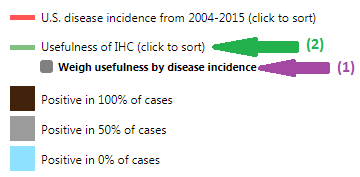
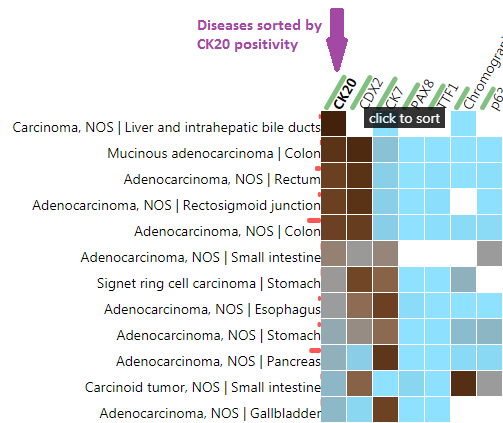
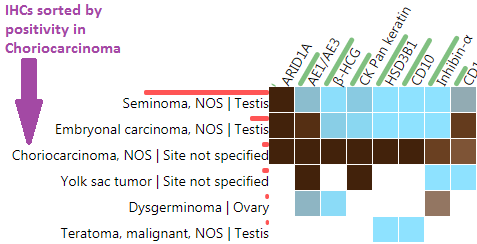
Get additional information
- To get additional information on a disease/IHC combo, hover the cursor over that tile. To view references, click the tile.
- To get additional information on a disease, such as incidence and ICD coding, hover the cursor over the disease label.